RASC Calgary Centre - The Expansion of the UniverseBy: Larry McNishPage last updated: March 17, 2012 Question: What is The Expansion of the Universe? Answer: The Expansion of the Universe is the increase of distance between objects in the Universe over time. Measurements of very distant objects (quasars, and galaxies) have shown that the further away they are from us, the faster they are receding (moving away) from us. This is NOT due to their own motion within the Universe. Space itself is expanding, "pushing" or "carrying" objects apart. And this speed is increasing with time (accelerating). The Expansion of the Universe:
Where Dark Energy gets the energy from to accomplish accelerating the growth of the entire Universe is unknown, and why it took several billion years to overcome the deceleration due to matter and dark matter is also unknown. This expansion applies to intergalactic space but NOT the things in it - which are held together by the other forces of nature - gravity (on smaller scales), electromagnetism and the strong nuclear force. On scales like our Solar System and all the galaxies in our Local Group, normal gravity is stronger. In fact, the huge Andromeda Galaxy, which is 2.5 million light years distant is actually heading towards us (or us towards them). According to Einstein's Theory of Relativity, although things "in space" cannot travel faster than the speed of light in a vacuum, space itself is unrestricted and can expand beyond this "speed limit". [Einstein showed that matter cannot travel at or faster than light, but since "space" is not "matter" the speed limit does not apply.] Objects (quasars, blazers, pulsars, and entire galaxy clusters) that are very, very distant may be "carried away" from us at faster-than-light speeds as the universe expands. In this case, we will never see them - their light itself is travelling slower than the expansion rate creating more distance between us per second than light can traverse in the same time. Such light has a losing battle trying to get to us, and therefore we will never see it. This means that there is a limit to how far we can see anything. All objects in the universe beyond that distance are undetectable. This "cosmic distance limit" defines the dimensions of our "Observable Universe" which is almost certainly only a small part of the Entire Universe. If you lived on a planet around a star in a galaxy at the edge of the Earth's observable universe, you would see your "quadrant" but even further away from our direction would be your own distance limit, perhaps containing another "quadrant" that cannot be seen from that position. And so on, perhaps to infinity. The diagram below puts several of these items together into one "Inflationary Cosmology" timeline for our Universe. 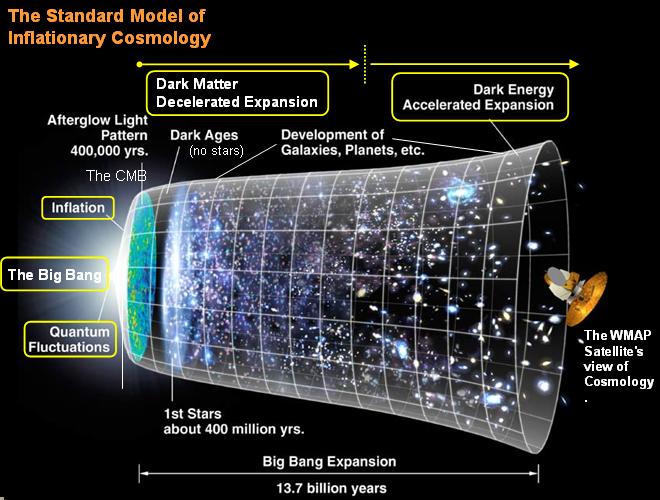 The Standard Model of Inflationary Cosmology (Credit: NASA/WMAP, additional annotation by the author.) Of course we can never achieve a view like this from "outside" our Universe. More information about the WMAP results can be found here. Bonus Answer - Why The Universe has no "Centre" of Expansion:
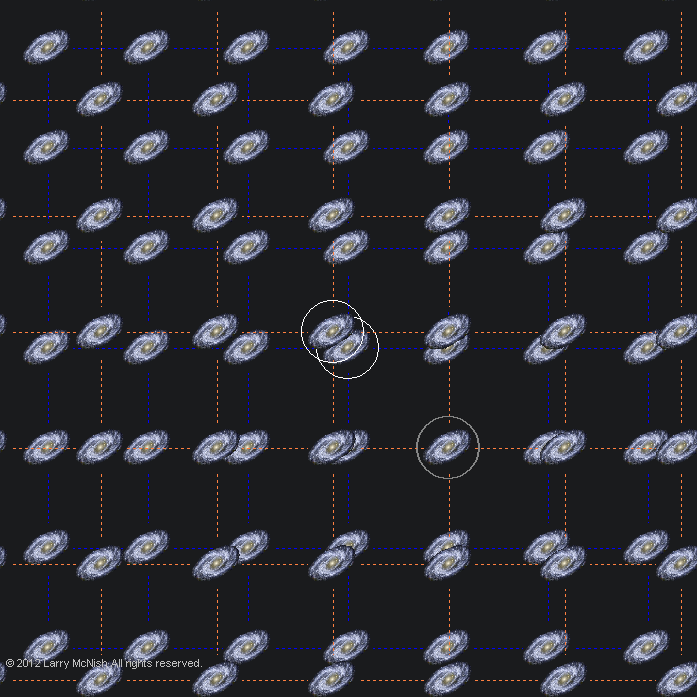
IMPORTANT DISCLAIMER ABOUT THE DIAGRAMS ABOVE The diagrams above serve to make the point I wanted, but they are not valid because:
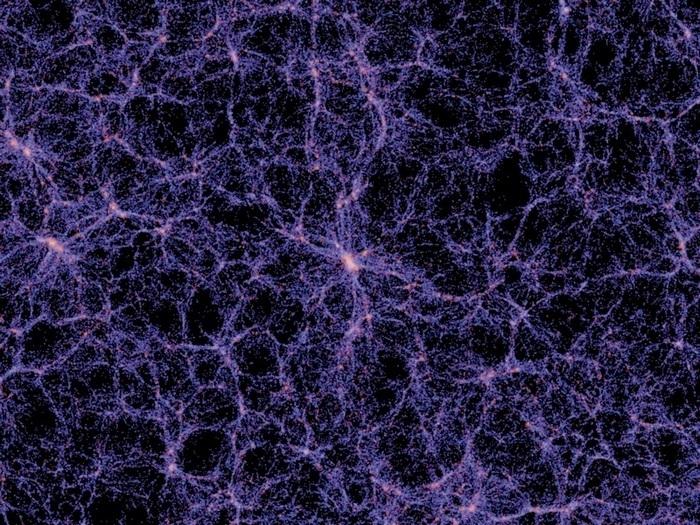 The Universe at a very large scale. Credit: The Millennium Simulation Project of the Max Planck Institute for Astrophysics. In the simulated image above, everything visible is a supercluster of galaxies. It is the dark "space" between them that is expanding. WHAT IS THE UNIVERSE EXPANDING INTO? There are two common analogies used to try to demonstrate the expansion of the space in our Universe:
There's another "cop-out" explanation - The word "Universe" means "All existing matter, energy and space considered as a whole, (also called 'The Cosmos')". If the "Universe" is everything, then there is nothing else and so the Universe cannot be expanding into it. Nice, but this does not really help. There is no simple answer. And, because we have an "Observable Universe" distance limit, we cannot precisely determine the answer. However, we can "speculate" about it. One of these speculations is that there are other universes (which contradicts the dictionary definition of 'Universe'). Each of these separate universes could have been created in their own "big bangs" and are expanding into ... well we need a new term for that, so astrophysicists that work on this solution have dubbed it "The Multiverse". Great - so this hypothesis states that our Universe is one "bubble" expanding into the "Multiverse". If so, then all universes could be expanding into the Multiverse - and does that mean the Multiverse is expanding? And, if so, what is IT expanding into? Nice, but this does not really help either. Another speculation is that the Big Bang created a stupendously enormous amount of "empty space" in our Universe, that all the matter is now expanding into, possibly an infinite amount of empty space exists beyond any observable distance. The little bit that we live in is expanding, but there is perhaps lots of room left to fill. Nice, but this raises the very similar question "What is beyond the end of the Universe?" Other theories speculate that "space is curved" so that, even if you could travel faster than light in a "straight line", you would simply be following curved space and end up back where you started (after a journey of several billion years). So, no answer there, either. The simplest answer is: WE DON'T KNOW - because we cannot get to a location "outside the universe" to see the entire universe and beyond. AND WE MAY NEVER KNOW - if the answer requires such a viewpoint. So. There you have it. This question is not answerable at this time, and may never be satisfactorily answered by anyone. | ||||||