RASC Calgary Centre - Cosmological Redshift
By Larry McNishPage last updated March 7, 2012
|
There are four phenomena that cause light to be seen as "redder" than the source that actually emitted it.
Since we can't go "out there" and obtain a sample of the light before it gets redshifted, we determine that a light source *has* been redshifted by looking for specific Fraunhofer lines in the spectrum of the received light. Because we believe that our "laws of physics" apply everywhere in the Universe, lines in the spectrum from common elements such as Hydrogen and Helium are expected to occur in a specific portion of the spectrum. We look for lines that match the element and we find them displaced from their "normal" (i.e. Earth laboratory) locations. The symbol for "Redshift" is "Z" and is a dimensionless number representing how much light has been shifted. (The formulas for the various types of red shifting can be found in the links above.) The total Redshift effect on a light source can therefore be represented by: Cosmological redshifts become much more dominant than other types of redshifting for objects outside our Local Group of galaxies (i.e. many millions or billions of light years distant). These redshifts are a result of the stretching of space-time, as postulated by general relativity, and not by radial motion. Therefore, the other types of redshifts can be ignored at great cosmological distances. In addition, photon energy varies as the inverse of the wavelength (ultra-violet short wavelength light has more energy than infra-red long wavelength light). Therefore, redshifted radiation also has a significantly reduced energy (brightness) by a factor of z+1. So distant stellar objects are not only faint due to their great distances, but their observed light loses energy by a z+1 factor making the task of recording their spectra very difficult. However, measuring an objects redshift does not directly give the distance to an object at the time the measurement is made. It doesn't even give the distance to an object at the time the light was emitted. Consider the following diagram which is divided into three sections (A, B, and C) showing a pulse of light starting off from a source galaxy (A) to the Earth where it gets observed (C):  A - During the early Universe about 670 million years after the Big Bang, 13 billion years ago, perhaps when our galaxy and solar system were starting to form, light from the galaxy A1689-zD1, 3.35 billion light years away (e.g. a pulse of NOVA light) leaves that galaxy and starts its travel towards our location. I use a pulse of yellow light in this example because it may be easier to understand than a continuous stream of light of all colours from all the sources in the galaxy. I also show an example spectra where just two Fraunhofer_lines are shown. In reality there would be many different lines that will be redshifted. B - Over the next few billion years, the Universe and our solar system evolves to the point where the Earth exists as a molten planet. During this time, the light pulse has travelled a great distance, but has not yet reached the Earth. The light also gets "stretched" due to the expansion of the Universe on such large scales. The wavelength therefore would appear shifted towards the orange part of the spectrum (if someone were "out there" to observe it). In addition, its intensity drops due to the distance and the loss of energy by the photons. You should also note that due to the expansion of the Universe, the source galaxy has receded from its original location and now lies several billion light years further away. Again, this is not caused by its "proper motion" i.e. local motion through its region of the Universe, but by the expansion of space between "us" and "it". C - Today, 13 billion years after the pulse of light left the galaxy, detectors on our "Blue Marble" finally receive the light pulse that has been travelling for 13 billion years against the expansion of the Universe. Its wavelength is much longer (red-shifted) and its amplitude (intensity) is much smaller (requiring large telescopes to gather enough light to even see it, let alone enough light to create a usable spectrum.) Meanwhile, the galaxy source itself, has been moving further and further away from us due to the expansion of the Universe. And at large distances, the expansion rate increases with distance, so now the galaxy is very far to the right (i.e. off the diagram). So:
The light would take longer to reach us, be even weaker, and be even further red-shifted (perhaps even down into the "radio" portion of the spectrum). This is why the light from the furthest "event" we can observe is called the CMB - Cosmic Microwave Background radiation - i.e. light that now appears to us as microwaves. The CMB measurements give us the estimated age of the Universe at 13.7 billion years. Other References: http://en.wikipedia.org/wiki/Redshift http://www.asterism.org/tutorials/tut29-1.htm A calculator, that given a redshift value "Z", can calculate the original source distance, the light travel time and the current source distance: http://www.astro.ucla.edu/~wright/CosmoCalc.html (To reproduce the values shown above, enter a "Z" of 7.85 and click on "General".) By the way, if you think that finding and matching Fraunhofer_lines from elements in the spectrum of different stars or galaxies is simple and easy, consider the spectrum of our Sun showing the lines from all the different elements in the Solar surface, the Solar Corona, those added by intervening Solar System material, and the Earth's atmosphere as shown below: 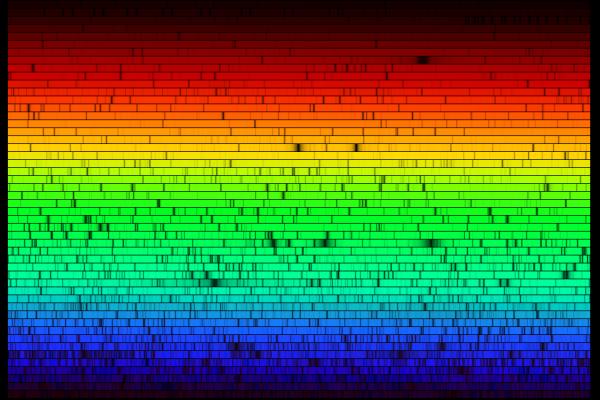 Image Credit: NOAO/AURA/NSF from: http://www.noao.edu/image_gallery/html/im0600.html Then consider that the lines would be shifted by an unknown amount, that additional lines from the ultra-violet end of the spectrum would be "shifted in" to the blue, and that lines from the red end would be "shifted out" to the infra-red end. |