The Transit of Mercury - November 8, 2006Articles and PhotographsPage last updated November 14, 2006
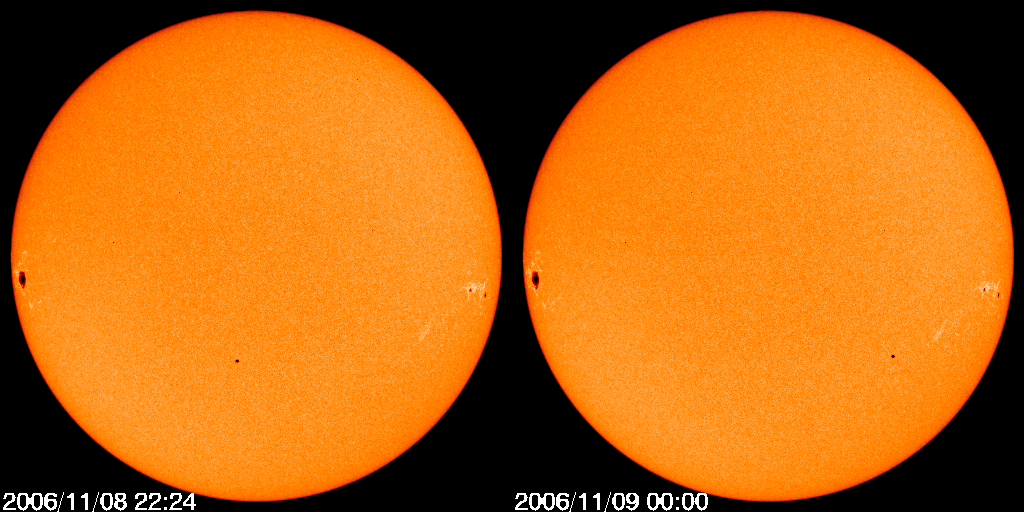
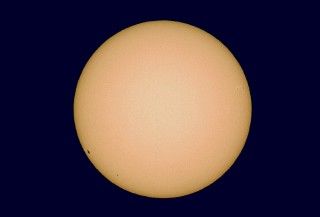
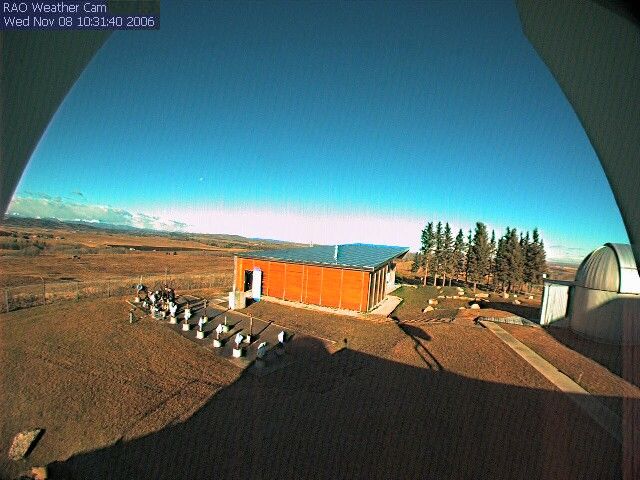
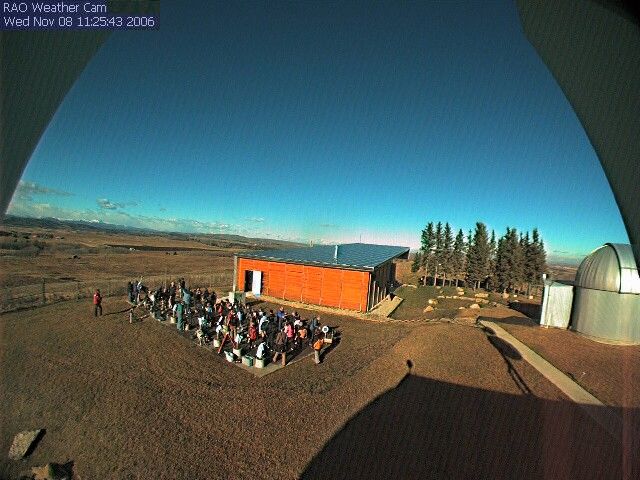
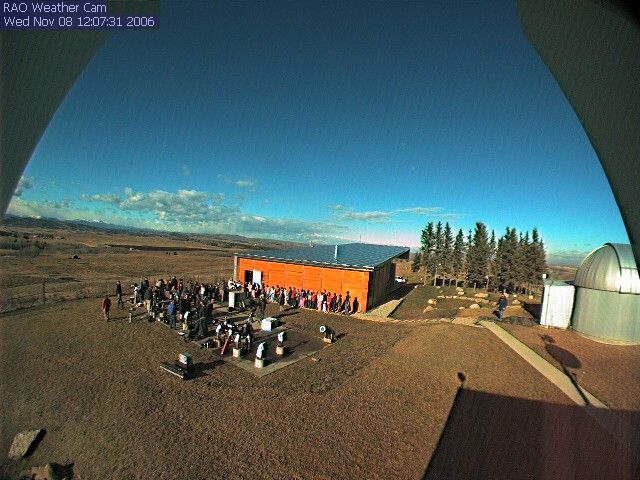
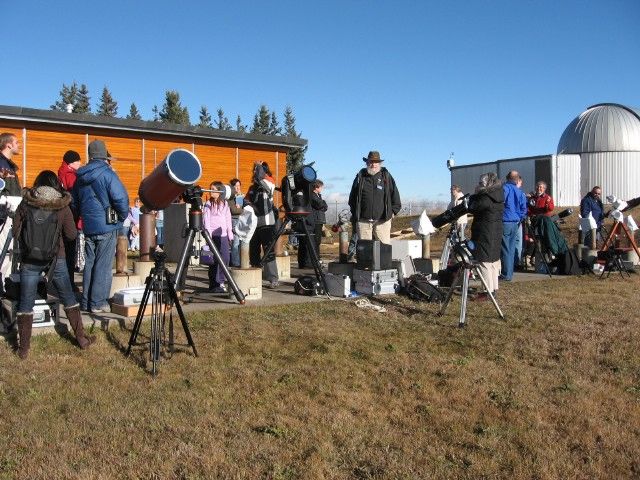
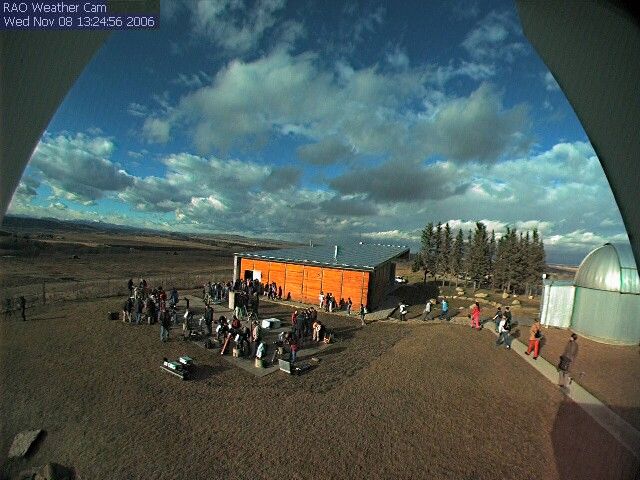
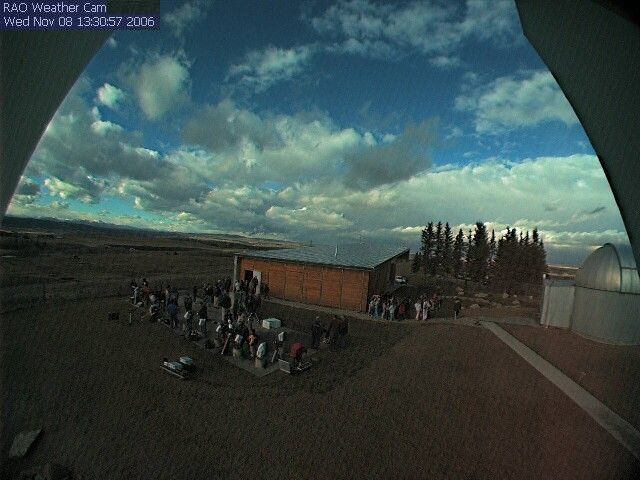
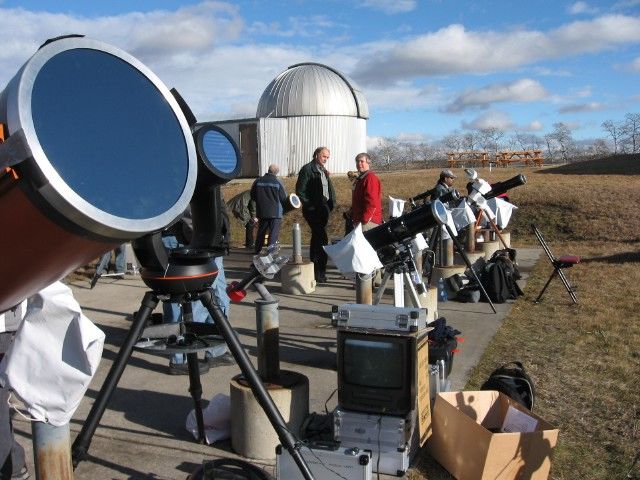
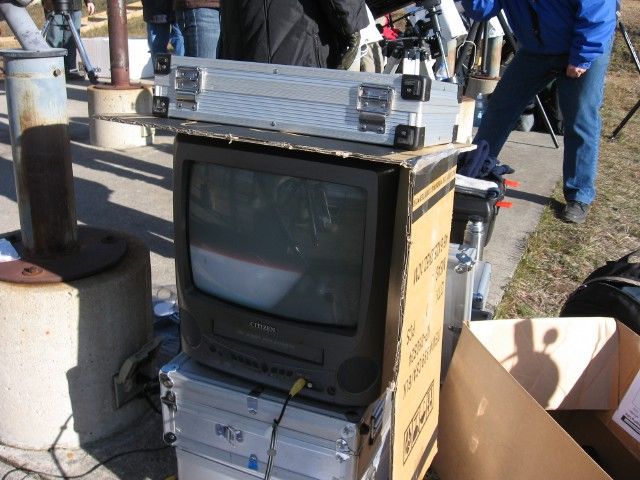
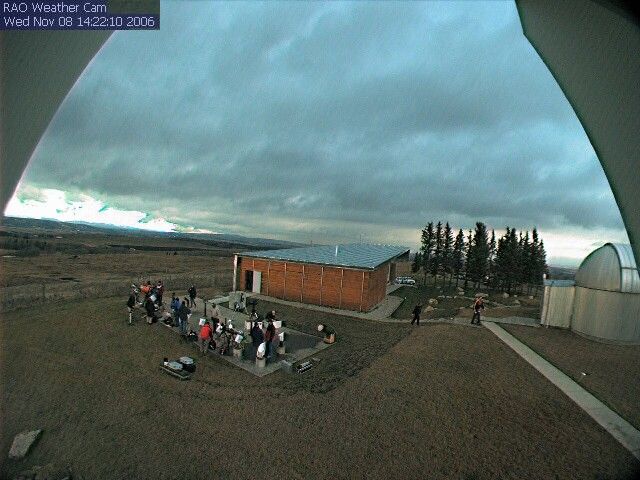
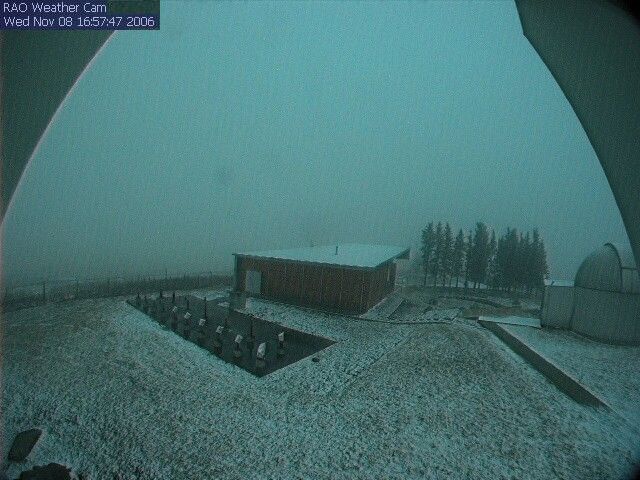
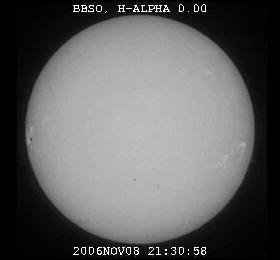
1. Larry McNish On November 8, 2006 the University of Calgary's Rothney Astrophysical Observatory (RAO) south-west of Calgary became "Transit Central" for astronomers from the U of C, Alan Dyer of the TELUS World of Science, and the Calgary Centre of the RASC. I had proposed the RAO location back in July due to its excellent elevation and good south-west view. The November Sun would be fairly low in the south and south-west during the event which would last from 12:12 MST until sunset at 16:59 MST - unfortunately just before 3rd and 4th contacts. The staff of the RAO (Dr. Phil Langill and Jennifer Howse) agreed to host the event at their Visitor Centre and Observing Deck. University of Calgary Astronomy students volunteered their time to set up their large C14 scope and assist with showing the event to the public. Alan Dyer agreed to attend and give a presentation on the Historical Significance of Transits. A number of Calgary RASC members with solar-equipped telescopes also volunteered their time and equipment to show the event to members of the public. The announcements went out and we hoped for clear skies. The days leading up to November 8 were variable with sun, clouds, rain - just about everything Calgary weather can throw at us. However, As I drove to the RAO on the morning of November 8 the skies were clear except for a band of cloud along the foothills to the west. The Sun was shining in the south-east, and the moon was shining in the north-west. We arrived at the RAO observing deck and set up our equipment. There were about 10 solar-equipped scopes, the largest number of scopes I had seen there even including the RAO Open House sessions - a good indication of the interest generated by this event. It wasn't long before I had the Sun in my C8 and was observing a large sunspot on the eastern limb - a good indication that the "seeing" was adequate to see the tiny black dot of Mercury as it would begin the transit close to that limb. I had also brought along a collection of borrowed equipment: - my computerized camera platform, the little C90 scope from the Calgary RASC Scopes for Rent program, a B&W video camera "eyepiece" from Phil Johnson, a 13" television/VCR and a number of video cables and adapters. The objective was to provide a video feed of the event to the public if all worked well. Well, it actually did! The combination of scope and camera provided an approximately 250 power view and we could clearly see the big sunspot and the tiny disk of Mercury on the screen as the transit progressed. Luckily I remembered to start the recording. Don Hladiuk (who operates the Sandia all sky camera) volunteered to convert the VHS tape to a video file. The third thing I had planned was to capture the images from the RAO Weather Cam as a record of the event - some of those pictures are shown below. As with most Solar viewing, it is not easy to get a perfect scope alignment so the U of C volunteers and the RASC people stood by their equipment for the whole session ensuring the public got a good view through a number of different scopes with a number of different filters. Alan's Hydrogen-alpha Coronado was a great view - clearly showing solar prominence. Things went very well until about 2:00 PM when those darn clouds on the western horizon moved over south-central Alberta and stopped the show. I would like to thank the following volunteers from the Calgary Centre of the RASC for taking time off work for this middle-of-the-day, middle-of-the-week public event.
^ top 2. Alan Dyer The bad weather held off for long enough for us to see the first two hours of the transit from noon on, then the clouds thickened and by 3 pm it was snowing, and by 5 it was a blizzard and the highways were being closed! So we did very well. We had a public session at the University of Calgary's Observatory where we had an excellent horizon, lots of room for scopes and a nice speaking venue for talks in their new Visitor Centre. The early afternoon was beautiful -- sunny and mild for November. Except for those who came too late, everyone had a good look, and the view thru the H-alpha scope was neat -- seeing clean separation of Mercury on the Sun well while it was still entering the limb in white light. Mercury also entered the disk right below a prominence -- I did not see it against the prominence before contact.
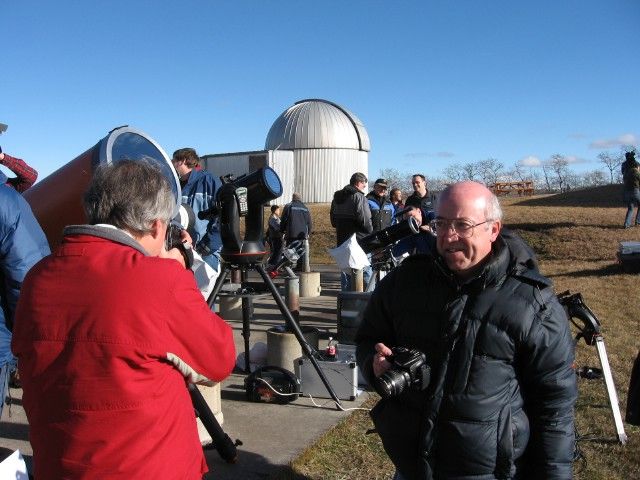
^ top 3. Don Hladiuk Don Hladiuk converted my video tape of the event to the mpeg files above (thanks Don!). Don also took a couple of crowd shots as well:
^ top 4. Dr. Phil Langill - RAO Director Well a miracle occurred this week, and with the help of all you good volunteers, about 150 members of the public were able to witness one of natures coolest astronomical events. The weatherman was 95% right, and thankfully that 5% error was in our favor. We didn't see the whole transit, but the first hour and a bit was great. Special thanks to Larry McNish, Jennifer Howse, Alan Dyer, the RASC volynteers, and the UofC volunteers:


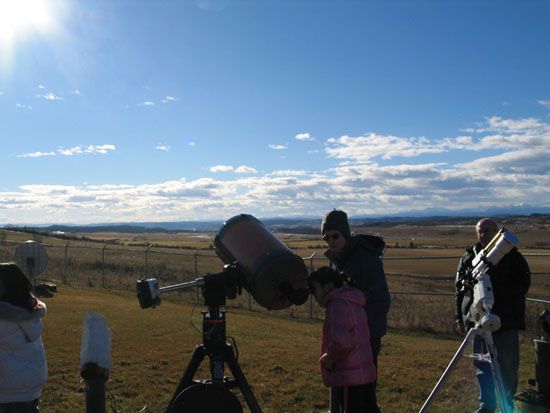


^ top 5. Blair Colborne Calgary RASC Youth Group Director Blair Colborne was at Henry Wisewood High School for the Transit. I took 3 telescopes with solar filters. Myself and 3 teachers manned the scopes. 35+ students got to see the first part of the Transit of Mercury before a cold front went through clouding us out. The pictures below were taken by one of the students. She hand held her digital camera over the eyepiece to get the shot.
^ top 6. Murray Paulson (Edmonton Centre) Well, the day started off pretty poorly with the weather forecast flipping from clear and sunny as posed on Tuesday to overcast, freezing rain and snow on the morning of the Transit. Damn! This looked just like an instant replay of my 1999 November 15th (unsuccessful) Mercury Transit. I could feel anxiety and caffeine mixed with the certain fear that I was about to miss my 3rd, or was that 4th, Mercury transit in a row! I checked out the AMA road cameras and saw that the southern end of the province was clear and sunny (Calgary to the border). Not what the weather maps had predicted yesterday. I talked to my friend Alister, a weather man, and the prediction at noon was that the skies would clear from the northwest and we would eventually get a clearing if we waited it out, probably at around 2:00 pm. Just after 1:00 pm I saw the IR+visible AVIs update on the weather office website showing the downward flow being upstaged by an upward flow coming out of the west beyond Hinton. I could now see the clearing bubbles over the Swan Hills heading east, not south. Damn, again. I made a last call to Alister and he confirmed the bad news. I finally decided to run for it and head North. The Sky 90 and the rest of my equipment had been packed and in the car since 12:00. I left the house just before 2:00 and headed north on highway 2 out of St. Albert. About 5 km north of Morinville, I noticed a band along the horizon that was decidedly bluish, the sky brightened and I had to put on my sunglasses. A ways North of Legal, the sun broke through and you could see shadows. Yahoo! I could see that the clearing from the west was moving east, so I turned east at Clive corner and continued north on the road to Athabasca. About 5 km north, I pulled into a side road and found a pull out into a farmers field where I had a good view to the south west. I set up and with the 4.8 Nagler caught my first glimpse of Mercury on the sun. A black blob crawling like an amoeba, and the edge of the sun looked like a circular saw blade. Way too much power for a warm scope and crappy seeing, especially with the sun down low and near the edge of a cloud band. Back down to my trusty 13 Televue Plossel at 50 power. Now that looked good, and I could see a big sunspot lurking near the edge of the sun. Nice. Things stabilized and that black dot crisped up affording a very sharp view. I reflect on the Venus transit and how much bigger the disk of Venus was on the disk of the sun. The placement and trajectory of the planet's disk was almost exactly the same as well. Very cool. I watched until about 4:00 when the sun set into the cloud band. The layers of cloud crossing the sun made the image reminiscent of Jupiter with a shadow transit. When the sun went out it got cold fast with the wind that had picked up from the west. Time to pack up. I had intended to set up the Canon Rebel and shoot some images of the transit, but discovered that a crucial adaptor had been left behind. Damn yet again!!! So a drawing in my logbook will have to do. My Mount, the Takahashi Teegul, worked flawlessly and handled the buffeting of the wind without too much ado. Next Mercury transit is only 10 years down the road. I should be ready by then, and I won't forget my adaptor! ^ top | |||||||||||||||||||||||||||||||||||||||||||||||||||||