RASC Calgary Centre - What if Earth Had a Second MoonBy Larry McNishPage last updated April 7, 2020 Page originally created April 2, 2020 Answer: Predicting the Earth's tides (how big, where, and when per day) is one of the most difficult problems in mathematics and astronomy. It is said that Newton (who invented the laws of gravity and planetary motion) said solving that prediction problem nearly made him mad it was so complicated.[Citation needed but I can't find one] And Newton never succeeded in coming up with a complete simple mathematical formula solution. If there are just two objects in a region of space that are orbiting each other, the solution is fairly straightforward according to Newton's law of universal gravitation. When there are three objects (e.g. the Sun, the Earth, and the Moon) orbiting around each other and co-affecting each other, it is called the "3-Body Problem" and no mathematical formula has ever been worked out that totally solves a 3-Body problem. The best that we can do is to "model" the gravitational attraction between the Sun-Earth, Earth-Moon and Sun-Moon and let the computer model run over time until it needs adjustments when it no longer predicts the reality of the tides. The first "computational" attempt to solve this complicated problem was the Tide-predicting machine conceived by Sir William Thomson and built in 1872-3. and designed by Thomson and collaborators, at the Science Museum, South Kensington, London 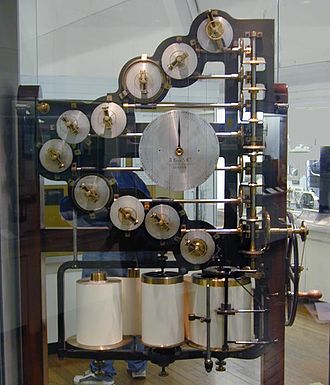 Image credit: The Science Museum, South Kensington, London Now, if we add a second Moon to Earth that has any significant size and distance from the Earth's centre we get a "4-Body Problem". At the current state of mathematical theory - we have no way of "solving" that, and again would have to rely on a computer model. Then astronomers would have to accurately measure the positions of all 4 objects every so often, and add or subtract "adjustment terms" to the model to make it agree with the actual positions. It would never be a "complete" model. If we consider the rest of the Solar System as well (mainly Jupiter) ALSO contributing slightly to the pulls that the Sun, Earth and Moon feel, then we get what is called the Dynamic Solution to the problem. This consists of 10 sets of data (Sun and 9 planets), with up to 16 parameters each, and a mathematical model that takes all that, and time, into consideration to provide an answer as to where the Sun and planets are. (Ref: https://ssd.jpl.nasa.gov/?planet_pos#formulae and: https://ssd.jpl.nasa.gov/txt/aprx_pos_planets.pdf) OK, so it would be mathematically complicated but for all real-word purposes it could be done. The net effect on the tides would by a combination of the Lunar Tides (twice a day), the smaller Solar Tides (twice a day) and the 2nd Moon tides - which depending on its size and orbit could be a few or many tides per day. Periodically the tides would "add up" to be either a higher tide, or they could "even out" to become a lower tide. ("neap" tides and "spring tides"). See: https://en.wikipedia.org/wiki/Tide.  Note: This animation spans a month - the time it takes the Moon to orbit the Earth. You have to imagine the Earth spinning around about 28 times during this interval and locations around the Earth encountering these tides every day. We can safely say that there is no object of any significant size anywhere in the Solar System that could "wander in" and become an Earth 2nd Moon. What is possible (and has happened) is that a tiny asteroid might come near the Earth and get captured by the Earth-Moon system. This would result in two things:
If the Earth ever had a second Moon that was of any significant size, it would most likely have been ejected from the Earth-Moon system millions or billions of years ago due to the instability of the orbits of objects within a 4-Body system. It's a good thing we aren't living on Jupiter with 79 moons, or Saturn with 82 moons, Uranus (27), Neptune (14), or Pluto (5). Calculating the tides would be a tremendous job. p.s. Here's a scale diagram animation showing that the Moon does not orbit a "stationary" Earth, but due to the large size (and mass) of the Earth's Moon, they both orbit around a "common centre of gravity" called the Barycenter, which makes the Earth seem to "wobble" as seen from the Sun.  More information on this can be found below the diagram here: https://calgary.rasc.ca/barycenter.htm And here is a 50 year animation of the Sun's actual location in space which varies due to the pull of all the planets in their various orbits. from: https://calgary.rasc.ca/orbits.htm#barycenter  You can see a similar scale-diagram animation of the Moon orbiting the Earth and causing the Earth to wobble as it orbits the Sun above. |
Return to main page