The Solar System
The Solar System consists of the Sun and numerous other objects either orbiting the Sun or orbiting another body which orbits the Sun.
The other objects belong to one of the following major categories:
- Planets (as of August 24, 2006 the planets are now defined to be: Mercury, Venus, Earth, Mars, Jupiter, Saturn, Uranus, and Neptune)
- Dwarf Planets: Ceres, Pluto, Eris, Makemake, and Haumea
- Moons (See my FAQ page for a list of the number of moons discovered so far)
- Asteroids - more than 1,000,000 of these have been discovered in many groups in different places in the Solar System, but most occupy the "Asteroid Belt" between Mars and Jupiter
- Trans-Neptunian Objects (TNOs) - more than 1600 of these have been discovered orbiting past Neptune in the Kuiper belt.
 https://www.universetoday.com/145367/over-a-hundred-new-large-objects-found-in-the-kuiper-belt/
March 12, 2020.
https://www.universetoday.com/145367/over-a-hundred-new-large-objects-found-in-the-kuiper-belt/
March 12, 2020.
- Comets - there are more than 300 "periodic
comets" (those whose orbits are known to repeat)
and dozens of "non-periodic comets"
(those that have been observed only once) many of which come from the extremely distant Oort Cloud
The Kuiper Belt and the Oort Cloud (image from NASA)

The Minor Planet Centre
The Small Solar-System Bodies are documented at the Minor Planet Centre
of the Smithsonian Astrophysical Observatory, which provides analytical data on these as well as the following
3 amazing diagrams showing the distribution and location of these objects:
The Largest Bodies in the Solar System
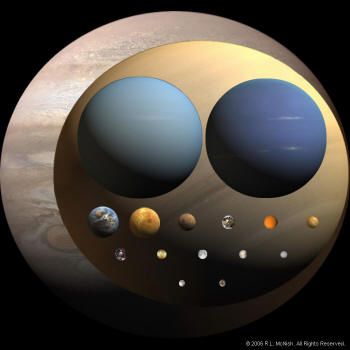
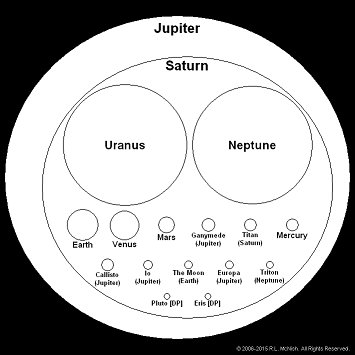
The following table lists all the other objects with a diameter greater than 2000 km in order of decreasing size:
Data as of April 2, 2015 from NASA:
| Object | Parent Body | Diameter (Km) | Previous value(s) |
|---|
| Jupiter | Sun | 142984 (Equatorial) 133708 (Polar) |
| Saturn | Sun | 120536 (Equatorial) 108728 (Polar) |
| Uranus | Sun | 51118 (Equatorial) 49946 (Polar) |
| Neptune | Sun | 49528 (Equatorial) 48682 (Polar) |
| Earth | Sun | 12756.2 (Equatorial) 12713.6 (Polar) |
| Venus | Sun | 12103.6 |
| Mars | Sun | 6792.4 (Equatorial) 6752.4 (Polar) |
| Ganymede | Jupiter | 5262.4 | 5268.2 |
| Titan | Saturn | 5150 | 5151 |
| Mercury | Sun | 4879.4 |
| Callisto | Jupiter | 4820.6 |
| Io | Jupiter | 3643.2 | 3642.6 |
| The Moon | Earth | 3476.28 (Equatorial) 3471.94 (Polar) |
| Europa | Jupiter | 3121.6 | 3138 |
| Triton | Neptune | 2706.8 | 2705.2 |
| Pluto | Sun | 2374 (New Horizons mission, July 13, 2015) | 2306, 2329 |
| Eris | Sun | 2326 | |
The Relative Sizes of the Largest Solar System Objects - in the order above (to scale):
(click the images for larger versions)
|
|
Image Credits: individual object images - I.A.U. and NASA, concept and layout - Larry McNish.
Image processing and compositing - Chris McNish 2008/12/12. |
Here's a comparison of the Saturn system to Jupiter and the Earth-Moon system

And here's a comparison of Jupiter, its rings and 4 largest moons to the Earth-Moon system and the Juno spacecraft's orbit.

Also see: http://www.rense.com/general72/size.htm for a comparison between the Earth and other planets and the Sun and other stars.
The Small Solar-System Bodies (updated to July 13, 2015)
As noted above, there are hundreds of thousands of small bodies in the Solar System.
- The following table lists a selection of notable objects with a diameter less than 2500 km in order of decreasing size
and none that are smaller than Diemos - the smallest Moon of Mars.
The list includes:
- the 2 moons of Mars
- 12 of the 67 moons of Jupiter
- 23 of the 62 moons of Saturn
- the 27 moons of Uranus
- 13 of the 14 moons of Neptune
- the 5 moons of Pluto
- the 1 moon of Eris
- the 2 moons of Haumea
- the 1 moon of Quaoar
- the 1 moon of Orcus
- the 1 moon of Salacia
- The table includes only the largest 25 (up from 18) asteroids (with diameters greater than 200 km) of the 400,000 known Asteroids (items beginning with a 1 to 3 digit number)
from Wikipedia.
- The table includes the 5 classified Dwarf Planets [DP] Ceres, Pluto, Eris, Haumea, and Makemake (and their moons).
- The table also includes 22 other Probable Dwarf Planets [pDP] (with diameters greater than 600 km).
- (There are over one hundred other Dwarf Planet candidates.)
- The table now also includes the two largest Near Earth Asteroids [NEO] - 1036 Ganymed and 433 Eros.
- The table does not list any comets since the size of the coma is usually much larger than the nucleus and changes with distance from the Sun.
- (Data from NASA and Wikipedia.)
- Mike Brown, Professor of Planetary Astronomy at Caltech who discovered Eris and 15 other TNOs, keeps a list of Dwarf Planets at:
http://www.gps.caltech.edu/~mbrown/dps.html
| Object | Parent Body | Diameter (Km) |
|---|
| Pluto [DP] | Sun | 2374 |
| Eris [DP] | Sun | 2326 |
| Titania | Uranus | 1576.8 |
| Gonggong (2007OR10) [pDP] | Sun | 1535 |
| Rhea | Saturn | 1527.6 |
| Oberon | Uranus | 1522.8 |
| Iapetus | Saturn | 1469 |
| Makemake [DP] | Sun | 1430 |
| Haumea [DP] | Sun | 1540 |
| Charon | Pluto | 1212 |
| Umbriel | Uranus | 1169.4 |
| Ariel | Uranus | 1157.8 |
| Dione | Saturn | 1122.8 |
| Quaoar [pDP] | Sun | 1110 |
| Tethys | Saturn | 1062 |
| Sedna [pDP] | Sun | 995 |
| Ceres [DP] | Sun | 946 |
| Mani (2002MS4) [pDP] | Sun | 934 |
| Orcus [pDP] | Sun | 917 |
| Salacia [pDP] | Sun | 854 |
| Varuna [pDP] | Sun | 767 |
| 2013FY27 [pDP] | Sun | 763 |
| 2003AZ84 [pDP] | Sun | 747 |
| 2002UX25 [pDP] | Sun | 704 |
| 2004GV9 [pDP] | Sun | 703 |
| 2002AW197 [pDP] | Sun | 701 |
| 2005RN43 [pDP] | Sun | 697 |
| 2005UQ513 [pDP] | Sun | 693 |
| Varda [pDP] | Sun | 693 |
| Dysnomia | Eris | 684 |
| Ixion [pDP] | Sun | 674 |
| 2007JJ43 [pDP] | Sun | 616 |
| 2007UK126 [pDP] | Sun | 612 |
| Chaos [pDP] | Sun | 612 |
| 2010KZ39 [pDP] | Sun | 601 |
| 2012VP113 [pDP] | Sun | 601 |
| 2013FZ27 [pDP] | Sun | 601 |
| 2 Pallas | Sun | 544 |
| 4 Vesta | Sun | 525.4 |
| Enceladus | Saturn | 504.2 |
| Miranda | Uranus | 471.6 |
| 10 Hygiea | Sun | 431 |
| Proteus | Neptune | 420 |
| Mimas | Saturn | 396.4 |
| Nereid | Neptune | 340 |
| 704 Interamnia | Sun | 326 |
| Hi'iaka | Haumea | 320 |
| 52 Europa | Sun | 315 |
| Actaea | Salacia | 303 |
| 511 Davida | Sun | 289 |
| 87 Sylvia | Sun | 286 |
| Vanth | Orcus | 276 |
| 65 Cybele | Sun | 273 |
| Hyperion | Saturn | 270 |
| 15 Eunomia | Sun | 268 |
| 3 Juno | Sun | 258 |
| 31 Euphrosyne | Sun | 256 |
| 624 Hektor | Sun | 241 |
| 88 Thisbe | Sun | 232 |
| 324 Bamberga | Sun | 229 |
| 451 Patientia | Sun | 225 |
| 48 Doris | Sun | 222 |
| 532 Herculina | Sun | 222 |
| 375 Ursula | Sun | 216 |
| 107 Camilla | Sun | 215 |
| 45 Eugenia | Sun | 213 |
| 7 Iris | Sun | 213 |
| Phoebe | Saturn | 213 |
| 29 Amphitrite | Sun | 212 |
| MK2 | Makemake | 210 |
| 423 Diotima | Sun | 209 |
| 19 Fortuna | Sun | 208 |
| 13 Egeria | Sun | 206 |
| Larissa | Neptune | 194 |
| Janus | Saturn | 179 |
| Galatea | Neptune | 176 |
| Himalia | Jupiter | 170 |
| Namaka | Haumea | 170 |
| Amalthea | Jupiter | 166.9 |
| Puck | Uranus | 162 |
| Despina | Neptune | 150 |
| Sycorax | Uranus | 150 |
| Portia | Uranus | 135 |
| Epimetheus | Saturn | 116.2 |
| Thebe | Jupiter | 98.6 |
| Juliet | Uranus | 94 |
| Belinda | Uranus | 90 |
| Prometheus | Saturn | 86.2 |
| Elara | Jupiter | 86 |
| Thalassa | Neptune | 82 |
| Pandora | Saturn | 81.4 |
| Cressida | Uranus | 80 |
| Weywot | Quaoar | 80 |
| Caliban | Uranus | 72 |
| Rosalind | Uranus | 72 |
| Naiad | Neptune | 66 |
| Desdemona | Uranus | 64 |
| Halimede | Neptune | 62 |
| Neso | Neptune | 60 |
| Pasiphae | Jupiter | 60 |
| Bianca | Uranus | 51 |
| Prospero | Uranus | 50 |
| Setebos | Uranus | 48 |
| Carme | Jupiter | 46 |
| Hydra | Pluto | 45 |
| Sao | Neptune | 44 |
| Metis | Jupiter | 43 |
| Ophelia | Uranus | 43 |
| Laomedeia | Neptune | 42 |
| Cordelia | Uranus | 40 |
| Psamathe | Neptune | 40 |
| Siarnaq | Saturn | 40 |
| Sinope | Jupiter | 38 |
| Lysithea | Jupiter | 36 |
| Helene | Saturn | 35.2 |
| Nix | Pluto | 35 |
| Kerberos (P4) | Pluto | 35 |
| 1036 Ganymed [NEO] | Sun | 32 |
| Albiorix | Saturn | 32 |
| Stephano | Uranus | 32 |
| Atlas | Saturn | 30.2 |
| Perdita | Uranus | 30 |
| Pan | Saturn | 28.2 |
| Ananke | Jupiter | 28 |
| Mab | Uranus | 25 |
| Telesto | Saturn | 24.8 |
| Phobos | Mars | 22.2 |
| Francisco | Uranus | 22 |
| Paaliaq | Saturn | 22 |
| Calypso | Saturn | 21.4 |
| Ferdinand | Uranus | 20 |
| Margaret | Uranus | 20 |
| Cupid | Uranus | 18 |
| S/2004 N 1 | Neptune | 18 |
| Styx (P5) | Pluto | 18 |
| Trinculo | Uranus | 18 |
| Ymir | Saturn | 18 |
| Adrastea | Jupiter | 16.4 |
| Kiviuq | Saturn | 16 |
| Leda | Jupiter | 16 |
| Tarvos | Saturn | 15 |
| 433 Eros [NEO] | Sun | 13 |
| Deimos | Mars | 12.6 |
The Relative Sizes of the Small Solar-System Bodies - in the order above (to scale):
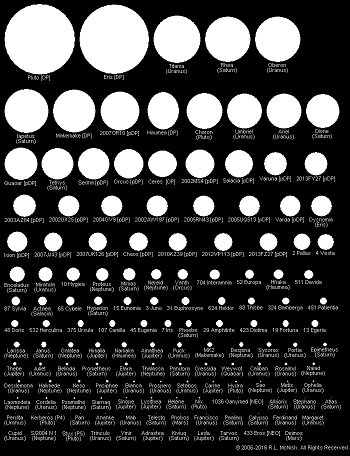
(Click for a larger image.)

Actual photos of Pluto, Charon, Hydra and Nix, and artistic impressions of the other
Largest Known Trans-Neptunian Objects (TNOs). (Click the image to see a larger version.)
IAU Resolution: Definition of a Planet in the Solar System
24 August 2006, Prague
Contemporary observations are changing our understanding of planetary systems, and it is important that our nomenclature
for objects reflect our current understanding. This applies, in particular, to the designation "planets".
The word "planet" originally described "wanderers" that were known only as moving lights in the sky.
Recent discoveries lead us to create a new definition, which we can make using currently available scientific information.
RESOLUTION 5A
The IAU therefore resolves that "planets" and other bodies in our Solar System, except satellites, be defined into
three distinct categories in the following way:
(1) A "planet" 1 is a celestial body that (a) is in orbit around the Sun, (b) has sufficient mass for
its self-gravity to overcome rigid body forces so that it assumes a hydrostatic equilibrium (nearly round) shape,
and (c) has cleared the neighbourhood around its orbit.
(2) A "dwarf planet" is a celestial body that (a) is in orbit around the Sun, (b) has sufficient mass for its
self-gravity to overcome rigid body forces so that it assumes a hydrostatic equilibrium (nearly round) shape 2,
(c) has not cleared the neighbourhood around its orbit, and (d) is not a satellite.
(3) All other objects 3 except satellites orbiting the Sun shall be referred to collectively as
"Small Solar-System Bodies".
1 The eight "planets" are: Mercury, Venus, Earth, Mars, Jupiter, Saturn, Uranus, and Neptune.
2 An IAU process will be established to assign borderline objects into either dwarf planet and other categories.
3 These currently include most of the Solar System asteroids, most Trans-Neptunian Objects (TNOs), comets,
and other small bodies.
IAU Resolution: Pluto
RESOLUTION 6A
The IAU further resolves:
Pluto is a "dwarf planet" by the above definition and is recognized as the prototype of a new category of Trans-Neptunian
objects.
Return to main page
|


