Light Pollution Abatement Site
Calgary Centre
Royal Astronomical Society of Canada

Light Pollution Abatement SiteCalgary CentreRoyal Astronomical Society of Canada |
|
So what is light pollution? Very simply it is light that shines where it is not needed or wanted. It is also lighting that is too bright. It is easily recognised as: light that shines off the property where the light fixture is located; light that shines onto your property or into your home; glary light from poorly aimed fixtures or that is too bright for its surroundings; and light that shines up into the sky.
The major sources of light pollution in Calgary are:
Light pollution has several forms, including glare, light trespass, over-lighting and uplight. Light pollution leads to energy waste and sky glow.
TYPES OF LIGHT POLLUTION
Glare is the uncomfortable brightness of a light shining into your eyes, leaving you unable to see much of anything else (extreme examples are the setting sun and oncoming auto headlights). Glare arises from a light source being brighter than its surroundings. It can cause annoyance, discomfort and loss of visual performance and visibility. Direct glare is the result of the light source shining into the viewers' eyes. Indirect glare results from objects that are too brightly lit (see over-lighting).
Veiling luminance is produced by bright sources in the field-of-view when superimposed on the image in the eye reducing contrast and hence visibility. This happens when bright objects are in the same or similar line of sight as the object being viewed. Veiling luminescence is worsened by fog, dust or defects in the viewer's eyeglasses or eyes such as cloudiness of the lens or scratches. Disability glare results in reduced visual performance and visibility. It is often accompanied by discomfort. Discomfort glare is glare that produces discomfort, but does not necessarily diminish visual performance.
Our eyes always adapt to the brightest light, making the surroundings appear darker. By reducing your ability to see, glare reduces safety and security. Remove the lampshades in your living room and you will experience glare. Even in Calgary at night, where roads are brightly illuminated, there is glare from streetlights and bright floodlights beside the road. If the light source itself is more apparent than what it is illuminating, then you have bad lighting. The rule of thumb is that you should only be able to see the light source if you are standing under the light. Glare is easily eliminated by using a shielded fixture that prevents light shining above the horizontal, and preferably lower than 20° below horizontal.
Glare always reduces visibility, is annoying, and can be hazardous. Always avoid creating glare.
Light trespass is light that shines where it is not needed or wanted. Also referred to as "light spill", light trespass is light from somebody else's property lighting up your property, shining in your windows, or otherwise interfering with your enjoyment of your property. Light trespass occurs whenever light shines beyond the intended target and onto adjacent property. It can be reduced or eliminated by using a shielded light fixture and by aiming lights down where the light can be used.
Over-lighting results when light levels exceed those needed for the task. Too much light often arises from a "more is better" philosophy, or from businesses trying to outshine their competitors (see ratcheting). Over-lighting results in indirect glare, where illuminated objects (buildings or car lots) are too bright compared to their surroundings.
Uplight is, quite simply, wasted light, wasted energy and wasted money. It occurs where improperly aimed or unshielded lights emit light above the horizontal. Light that never is used on the ground and simply goes up into the night sky serves no useful purpose. Uplight is what causes the dome of sky glow over towns and cities. Typically, lights that cause uplight also cause significant glare and light trespass. Unshielded yard or porch lights, most "security" lighting, most streetlights, and billboards with bottom-mounted lights are typical sources of uplight, light trespass and glare. Again, using shielded lights that are aimed down so that no light is emitted above horizontal will stop uplight and reduce light trespass and glare.
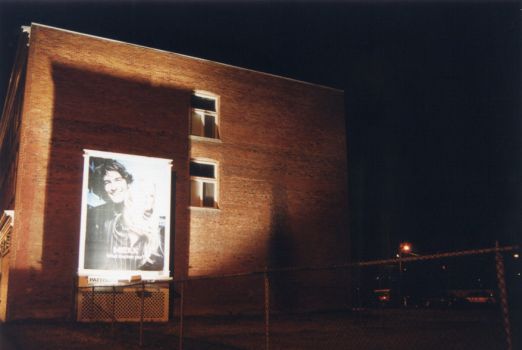
Uplight on a billboard shows how little light is actually used and that most light is simply squandered.
RESULTS OF LIGHT POLLUTION
Energy waste results from light pollution. Typically, 30 to 50% of the light we produce is never used, shining sideways or upwards instead. Misdirected light, using too much light, and leaving the lights on all night when nobody is around, are all wastes of energy. Calgary Roads estimates that about $2 million dollars of taxpayers' money per year has been sent skyward due to overlighting with inefficient streetlights - because of this, they are embarking on a massive program to change the streetlights (read all about this elsewhere on our website).
Sky Glow is the brightening of the night sky over towns and cities and is a symptom of light pollution, specifically of uplight. Sky glow is stray light in our atmosphere that can be seen for 100s of kilometres. The glow is caused by the scattering of artificial light by water droplets and dust in the air. The stray light mostly comes from poorly designed and improperly aimed light, and from light reflected from over-lit areas. The excess brightness obscures faint astronomical objects.

Sky glow over Calgary.
Calgary is one of the most light-polluted cities in the world. As pronounced as sky glow is over cities like Calgary, it represents only a small portion of the light that shines upwards. To truly understand the magnitude of the wastage problem, satellite imagery is very useful. Two examples of such images are the Earth at Night, which shows where uplight occurs, the Sky Glow map, which shows the effect on the night sky and the DSMP energy loss map, which shows how much energy is wasted. With the DSMP map, note how much brighter Calgary is than its peer cities in western Canada and the northwestern United States; we are throwing away more energy per square kilometre than the other cities.
Ratcheting is the marked increase in illumination levels by businesses for purposes other than safety. Bright lights are a way to attract attention when overly large signs and billboards are regulated or banned. Clever marketers have found that even when signs are tightly regulated, outdoor nighttime is generally not. Common in the United States, ratcheting is making inroads into Canada. It is characterised by glary fixtures, commonly facing outward from the commercial establishment towards adjacent roadways. Excessive display lighting at most auto dealerships is a perfect example. A newer use of excessive light is under-canopy lights at service stations. This new marketing technique is intended to attract customers and to make them feel safer; however, this over-lighting severely reduces a driver's ability to see as they leave a service station and drive onto the relatively darker roadway.

An example of ratcheting: low-end lighting used to market high-end automobiles. Note how these lights make the building stand out. But, a negative effect for the dealership is that the cars for sale are only poorly visible. Adjacent city streets also suffer from reduced visibility.
RESPONSIBLE LIGHTING
... is healthy lighting. We all need light for safety, security and utility. All of these uses can be achieved more effectively and cheaply if we avoid and reduce light pollution. Use only the right amount of light, shining where it is needed, without negatively impacting visibility or others' safety and enjoyment of their property.