Light Pollution Abatement Site
Calgary Centre
Royal Astronomical Society of Canada

Light Pollution Abatement SiteCalgary CentreRoyal Astronomical Society of Canada |
|
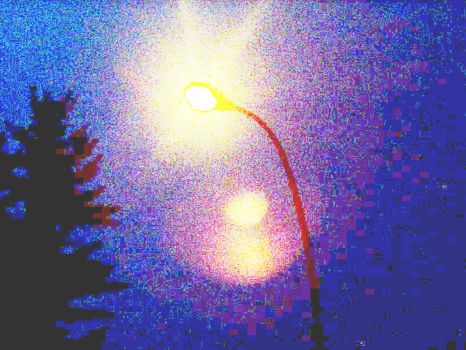
Waste light at night can have a strongly negative impact on plants. Care must be taken with artificial nighttime lighting to not change the daylight - darkness cycles to the point that plants are adversely affected.
Plants, shrubs and trees use sunlight for photosynthesis during the daytime, but at night they need darkness to regenerate a key compound - phytochrome. Nighttime lighting can reduce vegetation's ability to properly create this compound.
Phytochrome regulates a number of key processes in plants: photoperiodism, abscission, and dormancy and also regulates seed germination.
Light and Photoperiodism
Many plants measure the length of the nighttime dark hours as a means to determine when to bloom, set seed and lose leaves in the fall. By measuring the length of night, plants are able to anticipate the seasons. This photoperiodism is regulated by the slow production of phytochrome 660 from phytochrome 730 at night. Longer nights mean that more phytochrome 660 is produced. Some flowering plants require short nights, because phytochrome 660 acts as a bloom inhibitor in what are called "long-day" plants such as spinach, potatoes, some types of wheat, clover, henbane and lettuce.
Other plants use phytochrome 730 as the inhibitor; these are the "short-day" plants. Short-day and long-day terms are relative. A plant is classed as short-day if it will not bloom unless the day is shorter than a particular length (15 ½ hours or less for the "short-day" cocklebur plant), or it is classed as long-day if it needs a long daytime period (longer than 14 hours for spinach). Note that some short-day plants require longer days than some long-day plants.
As early as 1938, it was shown using the cocklebur, a short-day plant, that interrupting the nighttime darkness period with a light, for example a 1 minute exposure to an incandescent 25 W bulb, can prevent flowering. In this sense, short-day plants are truly "long-night" plants. All short-day plants, such as poinsettias, strawberries, primroses and some chrysanthemums, require uninterrupted periods of darkness to bloom and thus are negatively affected by light pollution.
"Bolting" and flowering of certain leaf vegetables, like spinach and lettuce, can lower the quality of the crop. "Bolting", the production of flower heads, is usually accompanied by toughening of the edible leaf parts as well as the redirection of nutrients away from the leaves to the flowers. Both spinach and lettuce are long-day (short night) bloomers, meaning that "bolting" can be enhanced under light polluted conditions.
Light and Leaf Abscission and Plant Dormancy
The length of nighttime darkness is a critical trigger for many deciduous plants to start the process of losing leaves in the fall (abscission) and entering a period of dormancy. Phytochromes mediate abscisic acid, which is responsible for these two actions. Artificial nighttime light can "fool" a tree into retaining the chlorophyll in its leaves too late in the season when deep frosts kill the leaves. Instead, the tree should be turning the various compounds of leaves into sugars and bringing these nutrients down into the roots for storage prior to the leaves being killed off. Trees and shrubs continue growing into autumn because of artificial daylight and fail to harden properly before winter. To properly cope with winter extremes, trees need to create special leaf-like structures to safeguard next year's growth locales. We know these as buds. The protective covers on the leaf buds are actually highly modified leaves coaxed into growing that way by high concentrations of abscisic acid produced by the tree and controlled by phytochromes.
Light and the Germination of Seeds
Just as phytochromes has divergent roles as regulator for short-day and long-day plants, it has similar dual roles in either enhancing or suppressing germination rates of plant seeds, depending on the species of plant. Again, as early as the first half of the 1900's, exposure to light was found essential for the successful germination of lettuce seeds. The U.S. Department of Agriculture determined shortly thereafter that it was red light of wavelength 660nm that was required - pointing to phytochrome 660 being converted to phytochrome 730. As long as lettuce seeds had the phytochrome 730 in them, they germinated. However, work by D.G.W. Edwards and Y. A. El-Kassaby (1996) in the science journal Seed Science and Technology, showed that germination in mountain hemlock, Tsuga mertensiana, was significantly reduced when seeds were exposed to light, this likely indicates that phytochrome 730 acts as a germination inhibitor in this plant.
Summary
Plants have evolved for specific day and night cycles and respond to these cycles through the production and consumption of the hormone phytochrome. Modifying these cycles with artificial nighttime lighting can alter the flowering cycle, the onset of dormancy in the fall and whether or not the plants' seeds will germinate. Depending on the plant species, nighttime lighting may induce or suppress flowering. Nighttime light helps both lettuce and spinach "bolt", which reduces the quality of the crop. Strawberries, on the other hand, require darkness to bloom. No blooms, no fruit. In trees, inadequate preparation for winter dormancy may result from light pollution. Phytochromes also have a complex role in the germination of seeds - light pollution can upset the natural ability for plants to germinate under the ideal conditions for each plant.