RASC Calgary Centre - Variable Stars
Variable Stars
by Jason Nishyama
Page last updated November 5, 2018
Variable Vision
This is an introduction to a field where amateur astronomers contribute valuable scientific data
to the professional community - the observation of variable stars. There are many mechanisms that
cause variability from the star pulsating to the star being eclipsed by a dimmer star. In this
article we will look at how to observe a variable star and how to determine it's magnitude at any
given time.
Now a lot of this work is done telescopically with either a photometer or CCD imager, but it can
be done visually, and without a telescope for some stars. We will look at observing the variable
star Algol (beta Persei) with the unaided eye. Algol is an eclipsing binary, and once every 2.87
days the dimmer companion star of Algol passes in front of the star blocking some of Algol's
light. This causes a noticeable dimming of the star, dimming from magnitude 2.1 to magnitude 3.4.
The dimming lasts about 8 hours so that it is possible to watch the whole event in an evening.
First you will need to determine when Algol will be at minimum. This can be done with the
Observer's Handbook where in the sky month by month section the minimum is listed. The key here is
to pick one where the minimum happens around midnight if you want to watch the whole eclipse.
Once you've selected a date that works for you, observe Algol once every 30 minutes. You will be
comparing Algol's brightness to other stars till you find one that matches in brightness. Find the
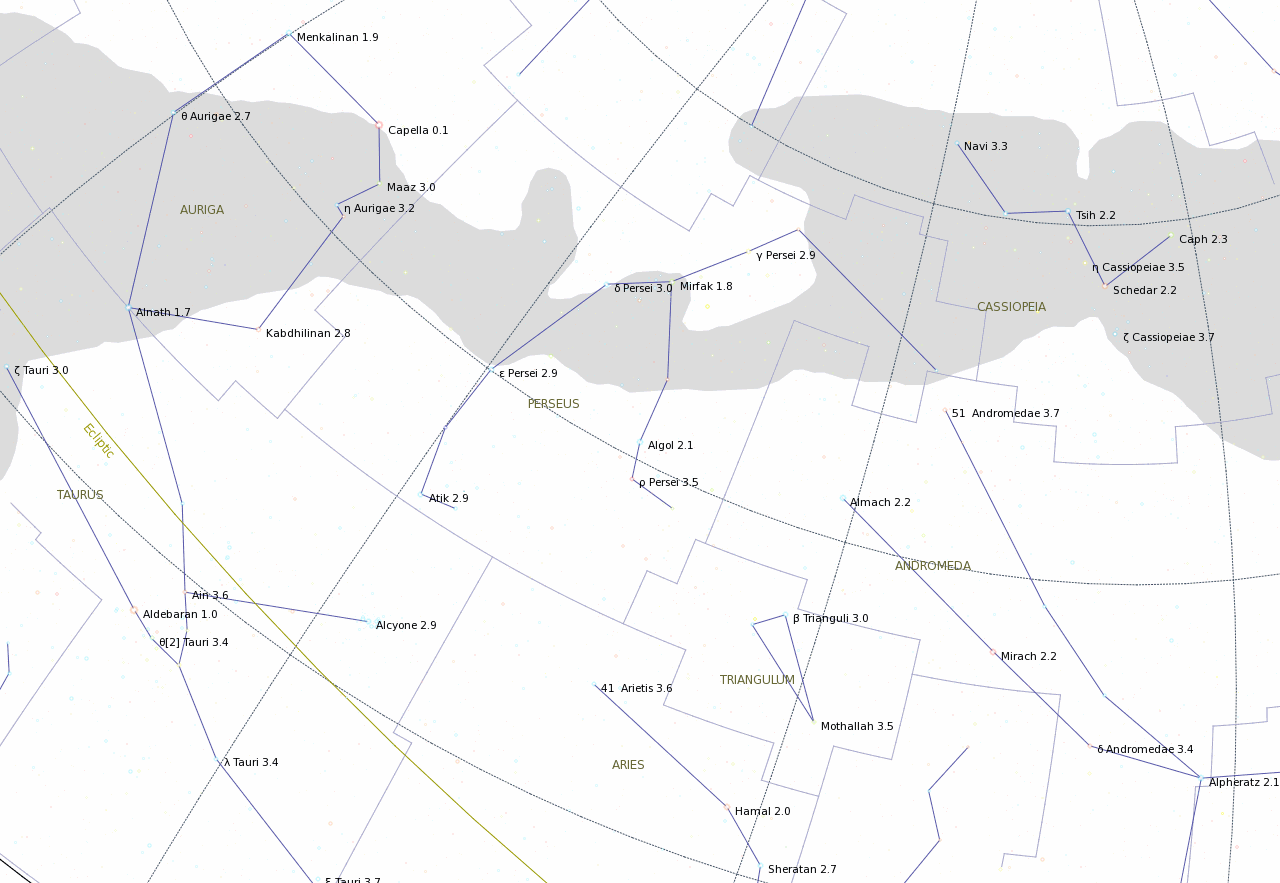
matching star on the map at the end of this article. The number beside the star is its magnitude
and hence the approximate magnitude of Algol at that time. After your observations you will have a
list of times and magnitudes which you can then graph into a light curve like the one below.

If observed over successive nights, a more complete light curve is possible. In fact if the period
of variability is known, the curve can be "folded" onto itself to make an even better curve.
The reason for the large input by amateur astronomers in the observation of variable stars is
simple - too many variable stars, not enough astronomers to watch them. This means that using
simple techniques, even the backyard astronomer can generate valuable data that may then be used
by professional astronomers in their work.
If you are indeed interested in going beyond this simple exercise, I would recommend checking out
the website of the American Association of Variable Star Observers (AAVSO) at www.aavso.org where you will find more information on variable star
observing as well as how-to guides and practice stars. Variable star observing is truly citizen
science.
Skymap for locating Algol and reference stars.
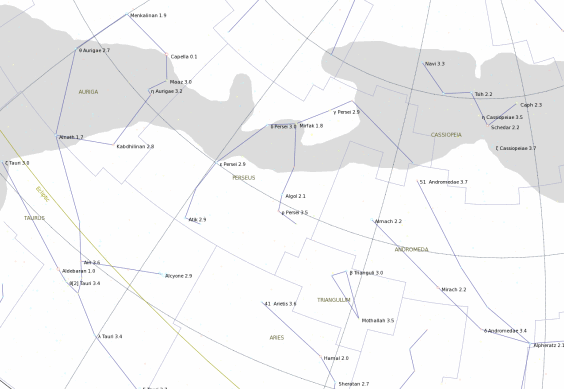
(Click for a larger printable version.)
|