RASC Calgary Centre - Tides
Tides
by Jason Nishyama
Page last updated November 5, 2018
The Tide is High...
People who live or grew up in coastal areas are familiar with tides, the daily rising and falling
of the ocean. Contrary to what certain American television political commentators believe, we do
know what causes them. It all has to do with differential gravity.
To see how this works let's do a thought experiment. Say you and a friend both have a mass of
75kg. Now lets say that you are currently standing on the surface of the Earth directly under the
Moon while your friend is standing antipodal, that is exactly opposite from you, on the other side
of the Earth like so:
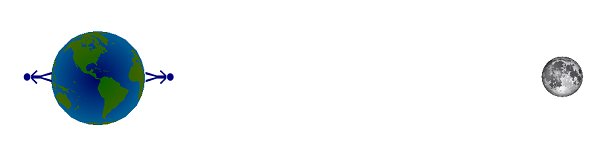
Now you are about 13000km closer to the Moon than your friend. This means that the Moon exerts a
greater gravitational pull on you than on your friend. This means that you feel the Moon pull on
you more than your friend does. In fact if we use this approximation for tidal force:
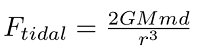
Where M is the mass of the Moon, m is your mass, d the distance between you and your friend (the
Earth's diameter) and r the distance between the Earth and the Moon, you can see that the tidal
force is about 0.00017N, a very tiny amount compared to the force the Earth's gravity exerts on
you and your friend of about 735N. This is good because if the tidal force was greater than the
force of Earth's gravity, you'd fly off when the Moon came by.
Now this force isn't enough to pull you or anything else off the surface of the Earth, but it is
enough to cause the water (and land) nearest the moon to be pulled up slightly forming a bulge.
Conversely on the other side of the Earth there is considerably less force accelerating the land
and water towards the Moon so it tends to get "left behind" and forms another bulge. The position
of the two bulges remains in more or less the same orientation to the Moon and since the Earth
rotates on it's axis faster than the Moon orbits the Earth, land masses "run into" the bulges
twice a day. This gives us our oceanic tides.
Now most of us know that, but tides play other roles in the universe.
Not only does the Moon exert a tidal force on the Earth, but the Earth exerts one on the Moon. It
is this force, acting on the dense mare on the near side of the Moon, that has locked the Moon to
only show us one side. Tidal forces cause orbital resonance that affect the rotation of Mercury
and the rotation of the moons of Jupiter.
Tides get even more interesting if the smaller object gets too close to the larger object. If this
happens, the smaller object enters the Roche limit of the larger object and the tidal forces will
rip the smaller object apart. So for example, the Roche limit for a rigid body is:

Where d_Roche is the Roche limit, R_1 is the radius of the main body, rho_1 the density of the
main body and rho_2 the density of the smaller body. So for the Moon, if it approaches the Earth
closer than about 18000km it will be ripped apart and form a ring about the Earth. This is likely
how many ring systems are formed with bodies pulled within the Roche limit of the planet they
orbited and pulled apart by tidal forces.
Now you may be wondering how things like us, satellites and the ISS (all within the Earth's Roche
limit) stay together and aren't ripped apart by tidal forces. It is because the Roche limit only
applies to object held together by gravitational forces, that is the are held together by their
own gravity. Satellites, the ISS and us are held together by electrostatic forces which are much
stronger than gravity and the tidal forces that the Earth generates are not strong enough to rip
apart objects as small as us. For that you'll need to visit close to a black hole!
Tidal forces are also found anywhere you can find differential gravity. The twisted shapes of
interacting galaxies are caused by the massive tidal forces that galaxies can generate. Black
holes can end up stretching objects held together by electrostatic forces (a process called
"spaghettification") with their massive tides.
So if you're ever close to the ocean and can watch the tide roll in or out, just remember, that's
a gentle tide, they can do so much more!
|


