RASC Calgary Centre - Sunspot
Sunspot
by Jason Nishyama
Page last updated November 5, 2018
Sunspots
In the summertime, a solar observing project seems appropriate. This project is actually quite
straight forward and can occupy you for a lifetime if you so desire. Basically the project is to
count sunspots.
The equipment needed for this is fairly simple, a telescope and most importantly a proper solar
filter.
IT IS IMPORTANT TO REMEMBER NEVER TO LOOK DIRECTLY AT THE SUN WITHOUT PROPER SOLAR
FILTERS.
A camera such as a DSLR is handy for this project and even with a solar filter shutter
speeds are quite fast so tracking isn't critical (or required) so this can also be a great starter
project for astrophotography.
Now coming up with a reportable sunspot number isn't as straight forward as it first seems. The
formula for computing a sunspot number is:
R=k(10g+s)
where R is the sunspot number, g is the number of sunspot groups and s the number of sunspots. The
k is a constant used to correct for observer, observing equipment and conditions. How this all
works can be best shown by an example.
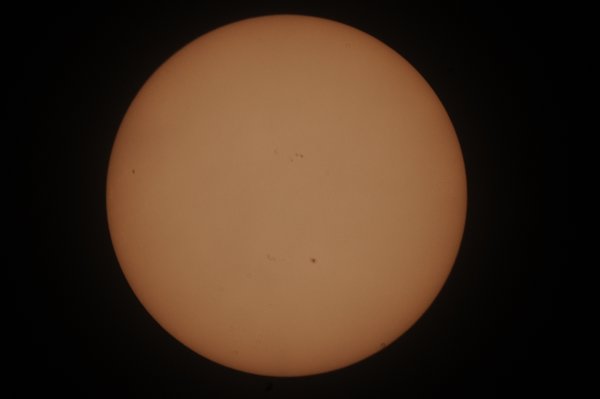
Figure 1 is a photo of the Sun taken with a DSLR through a 5" f12 telescope. There are some
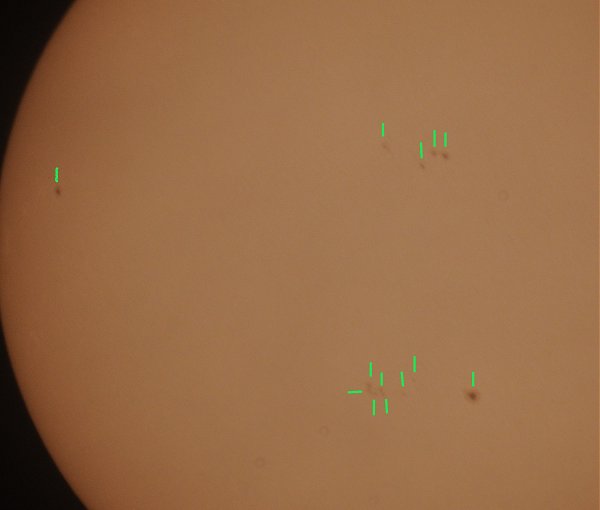
obvious sunspots on the face of the Sun. If we zoom in on the photograph [Figure 2] we can see
that there are 13 sunspots visible (marked by the green lines, the little doughnut shapes are
camera artifacts caused by dust on the sensor). This would be the value for s in our sunspot
number formula.
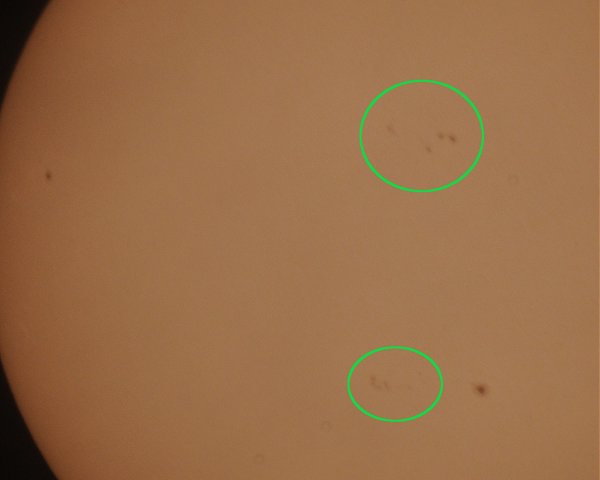
There are also a couple of obvious sunspot groups, circled in green in Figure 3. Added with the
two lone sunspots gives us 4 sunspot groups. This gives us a value for g.
So now we have values for s and g in the sunspot number equation. Since k is a correction factor
from what you've observed to what is the accepted number, to determine k you'll need to get the
accepted value of R for the day you did your observation. This value can be found at the Solar
Influences Data Centre's website (sidc.be). For the observation of the Sun in the photograph,
which was taken on the 26th of March 2013, the sunspot number is 63. Solving our sunspot number
equation for k we get:
k=R/(10g+s)
which for this example yields:
k=63/(10(4)+(13))=63/53 = 1.19
With a large telescope k is generally less than 1, but with a smaller telescope it can be over 1
as small telescopes may not see the smaller spots that larger telescopes can see. Once you have
determined the value of k, you can continue your observations and convert them to the
internationally accepted standard without having to refer back to the SIDC data (though for
greater accuracy you could take the k values from several observations and use the average going
forward).
Now you can carry forward with your own sunspot observations. Over time you can track the 11 year
solar cycle on your own or using SIDC data check to see how your data compares to the pros.
|


