RASC Calgary Centre - Moon Height
Moon Height
by Jason Nishyama
Page last updated November 5, 2018
Measuring a mountain.
In this instalment of quantitative astronomy we'll look at how to measure the hight of a mountain
on the Moon. This is another easy backyard project that requires only a tripod mounted telescope
and a stopwatch. This project works best around first and last quarter Moon and with mountains
close to the terminator, that is the point between day and night on the surface of the Moon. This
project can also be easily done in a single evening.
The observations are simple and similar to those used in the previous measurements of the moons of
Jupiter project. Time will be used to determine distance. For this a reasonably high power reticle
eyepiece is useful but not essential.
The first step is to work out how wide the Moon is, specifically how long it takes for the Moon to
drift by the reticle line or edge of the eyepiece. For this data, start your timer when the
western edge of the moon touches either your reticle line or the edge of the eyepiece and stop it
when the eastern edge reaches the reticle line or edge of the eyepiece. Record this time, you'll
need it later.
Next find a lunar mountain near the terminator that is casting a prominent shadow. Using the same
technique as you used for determining the width of the Moon, determine how long the shadow is. For
a first quarter Moon start your clock when the top of the mountain touches the reticle line (or
edge of your eyepiece) and stop it when the end of the shadow gets there. Reverse that for a last
quarter moon. Record this time.
Next you need to work out how far away the top of the mountain is from the terminator. Again clock
the time needed for the distance between the top of the mountain and the terminator to drift by
your reticle line or eyepiece edge. Record this as well.
You can do this for more than one mountain before you head inside to do the math if you so
choose.
Now the math I am presenting here for your data reduction is only accurate if you took your
measurements around first or last quarter moon and for features close to the terminator. A more
accurate method exists, but I will leave that as an exercise for the reader.
First we need to convert our times into distances. This is done with Formula 1 where T_moon is the
total time for the Moon to drift and T_dist is the distance you are trying to measure. If both
these times are in the same units, the result is a distance in kilometres.
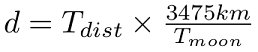
So you should now have the length of the mountain's shadow and how far away it is from the
terminator in kilometres. Now some simple geometry to work out how tall the mountain is. Look at
the following diagram Figure 1:
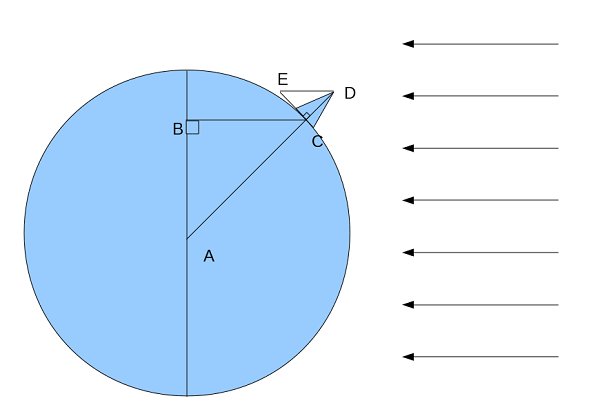
Triangle ABC is made up of a line from the mountain to the centre of the Moon, from the mountain
to the terminator and from the point where that line meets the terminator to the centre of the
Moon. This means that line AC is the radius of the Moon and you measured line BC above.
Further triangle CDE and ABC are similar triangles which means with the measurement of lines BC
and DE and knowing the radius of the moon line AC to be 1737km, we have enough information to
determine line CD, the height of the mountain. Using Formula 2 which relates the size of triangle
CDE to ABC and solving for line CD we get Formula 3 for the height of the mountain.
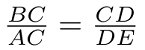

So place your shadow measurement as DE and the distance from the mountain to the terminator as BC
in Formula 3 and you will be able to calculate the height of the mountain in kilometres. This same
technique can also be used to determine the depth of a crater by measuring the height of a crater
wall that is throwing a shadow.
|


