RASC Calgary Centre - Listen Meteor
Listen Meteor
by Jason Nishyama
Page last updated November 5, 2018
Listening to Meteors.
With summer's long days and short nights an observing project for July and August is something
that can be done even if it's cloudy. I'm sending you on a radio astronomy project. Well
strictly speaking a radar astronomy project. The only equipment you need is a standard FM radio
and a comfy chair. All you need to do is tune the radio to a part of the band where there is no
local station, but to a station in another, distant city. So, for people in Calgary, tune into a
station in say, Regina. Normally you can't hear these distant stations, but when a meteor enters
into the atmosphere the ion trail it leaves behind it (what we visually see when seeing a meteor)
will reflect radio waves and you can hear the distant station for a moment.
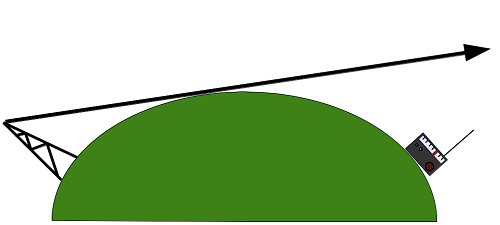
So how does this work? Well unlike AM radio which are ground waves, that is pulled along the
curvature of the Earth by the Earth's capacitance and shortwave radio which are sky waves, that is
reflected off the ionosphere from the transmitter to the receiver, FM radio and shorter waves are
line of sight. That is if you can't see the transmitter tower, you can't hear the radio station.
So if the station is over the horizon, such as in Figure 1, you can't hear the station.
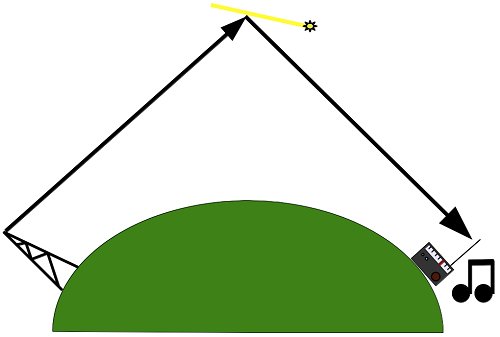
When a meteor enters the atmosphere, the friction of the air against the meteor heats up the
meteor, causing the glowing streak we're all familiar with. The glowing streak is so hot it is
made up of plasma, that is ionized gas. This ionized gas is reflective to radio waves. So for the
period of time the streak of a meteor flashes across the time this trail of plasma will reflect
the radio waves of the over the horizon station to your radio as in Figure 2.
So with two meteor showers in July (S. Delta Aquarids - 29th ) and August (Perseids -
13th) this provides an opportunity to listen to the showers. Even if it's clear, just set up a
portable radio beside your chair, tune it to an over the horizon radio station (preferably to the
east of you) and sit back and listen for the meteors. This will work at any time of the day and is
unaffected by cloud. Enjoy!
|


