RASC Calgary Centre - Jupiter Distance
Jupiter Distance
by Jason Nishyama
Page last updated November 5, 2018
More Solar System Measurement
In another article, we looked at a technique for measuring the orbital radii of planets inside the Earth's
orbit. This time we'll measure planets outside the Earth's orbit. I'll use Jupiter as an example
as it's quite bright and easy to spot, but any of the naked eye (or telescopic for that matter)
superior planets can be measured using this technique.
Unlike inferior planets, superior planets don't enter into a point on their orbits called Greatest
Elongation (see figure 1). There are points in the orbit where the superior planet is in what is
called quadrature, that is the angle between the superior planet and the Sun, from the point of
view of the inferior planet, is 90 degrees (though from the point of view of the superior planet,
the inferior planet is at Greatest Elongation). The other orbital geometry we need to know about
is opposition, or when the superior planet is 180 degrees from the Sun, or opposite in the
sky.

For this measurement at least two observations will be needed (assuming you look up what dates
opposition and quadrature occur, more if you don't and want to do this without cheating). You will
need your eyes, a watch and a calendar. Like measuring inferior planets you can do this the
armchair way and use tables and planetarium software, but where's the fun in that?
Unlike measuring the orbital radii of an inferior planet, you'll need to work out which quadrature
you're heading for. Using Jupiter as our example, if Jupiter has just reappeared from behind the
Sun, you will need to determine quadrature first. If you've missed this first chance at quadrature
(probably because you didn't want to get up in the morning as you'd be timing from Jupiter rise to
Sun rise) you can start with opposition and then work to the next quadrature as Jupiter heads back
behind the Sun.
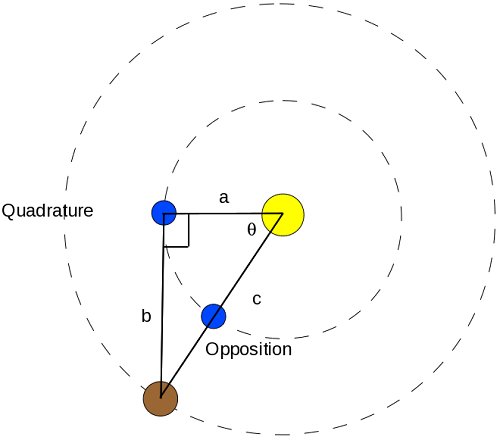
For this measurement the triangle is formed by our moving Earth. When we are at quadrature (figure
2) we know that the angle between Jupiter and the Sun is 90 degrees and the length of side a is 1
AU. What we need to figure out is the angle theta as shown in figure 2. We do this by letting the
Earth overtake Jupiter. Since we know how many degrees a day the Earth moves (~360/365), by
counting the number of days from quadrature to opposition (or opposition to quadrature) we compute
theta (we will also have to correct for Jupiter's motion, but more on that later).
On to the observations. For purposes of this example I'm going to assume we will measure from
opposition to quadrature (as opposed to the other way around) that way we are measuring from the
setting Sun to Jupiter and not the rising Jupiter to the Sun. Later nights versus early mornings.
If you're an extremely early riser, feel free to go the other way.
You can look up when Jupiter is at opposition in an almanac such as the Observer's handbook and
start there. If you want to have the spirit of adventure that a pure observation project can have,
you can start by observing Jupiter at any time, when Jupiter rises/sets 12 hours before/after the
Sun, it is at opposition. In other words, correcting for your observing location's displacement
from the local time zone (midnight in Calgary is 36 minutes after your watch says it is for
example) and for daylight savings time, Jupiter will be on the meridian at local midnight at
opposition.
From here you simply work out how many hours after the Sun Jupiter sets on your local horizon.
When that number hits 6 hours, you're at quadrature. Going from quadrature to opposition you
measure the increasing time from Jupiter rise to Sun rise until it hits 6 hours. You could also
simply see if Jupiter is on the meridian at 06:00 or 18:00 local time again corrected for DST and
your location.
Now that we know the number of days from opposition to quadrature, we are now done our
observations and can now work out the angle theta. Since the Earth moves, on average, 0.9856
degrees per day (360 degrees/365.2422 days) we multiply this number by the number of days it took
for us to go from opposition to quadrature. This almost gives us the value of theta.
I say almost because in the same time, Jupiter has also moved in its orbit. We will have to
subtract this from our angle. This is also simple to work out by dividing the number of degrees in
a circle by the number of days in Jupiter's orbit (360 degrees/4332.5 days=0.0831 degrees/day)
then multiplying this by the number of days between opposition and quadrature. We now simply
subtract the number of degrees Jupiter has moved from the number of degrees that Earth has moved
which gives us theta.
At this point we now know two angles and one side of the triangle in figure 2. We have a 90 degree
angle at quadrature and the side a is 1 AU. This makes the length of side c equal to:
c = 1/cos theta
Which will give you the orbital radius of Jupiter.
At this point I should mention that you'll sort of get Jupiter's orbital radius. If you use this
October's opposition and next January's quadrature, you'll notice that you get a result that is
somewhat less than the accepted value of Jupiter's orbital radius. This is due to the fact that
the elliptical orbits of both Jupiter and Earth mean that the number of days between quadrature
and opposition will vary as the distance between the two planets varies depending on where in
their orbits they are. As a thought experiment I used the program Xephem to determine the days
between both quadratures and opposition for the next six Jupiter oppositions. The number of days
varied from 85 to 92 days over that period. The average was 87.4 days, which is close to the
reported average quadrature for Jupiter of 87.5 days.
This shows the importance of repeating an observation over and over again. It also shows,
historically, why Copernicus had some difficulty getting his circular orbits to work with the
available data. Though it would work with the average of the vast amount of quadrature data
available to him at the time, Copernicus couldn't get it to agree with individual observations. It
would take Kepler to figure out why.
|


