RASC Calgary Centre - Galaxy Distance
Galaxy Distance
by Jason Nishyama
Page last updated November 5, 2018
Just How Far Away is That Galaxy?
Here we look at the confusing world of galaxy distances. Now you may ask
why I say confusing? That's because there are various ways of defining distance to the same object
when the object is really far away. We'll look at a few of them here.
The first is the light travel time distance. This is the distance most of us are familiar with.
This is simply the time it took the light to reach us multiplied by the speed of light (or just
the time if you want to measure in light years). So for example if we use the galaxy NGC 4860 the
light travel time distance is 113 million parsecs or 371 million light years. This is because it
took 371 million years for the light to get to us from NGC 4860. This is the distance that is
commonly reported in the media and what most people think of when talking about the distance to
galaxies.

Now the universe is expanding and in the time it takes the light to get from a distant galaxy to
us the universe expands somewhat. This is seen by us as the distant galaxy rushing away from us
(in reality we're rushing away from each other). So the actual distance between us and the distant
galaxy at this point in time will be somewhat larger than the light travel time distance. This
distance, called the comoving distance, is how far the galaxy is away from us, taking into
consideration the expansion of the universe during the time it took the light to get to us. So for
our example galaxy NGC 4860, the comoving distance is 115 million parsecs or 376 light years,
slightly farther. This also means that the distance between us and NGC 4860 increased by 2 million
parsecs in the 371 million years it took the light to get to us. Of course the farther away a
galaxy is, the greater the difference between the light travel time distance and the comoving
distance as the light has taken longer to get to us and the universe has expanded that much more.
One can think of the comoving distance as the actual physical distance between us and the galaxy
at this moment in time.
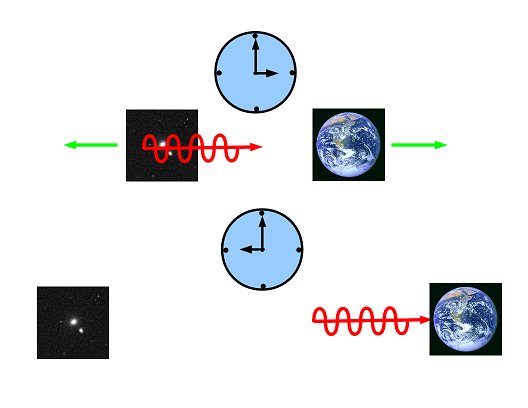
Of course when the light was emitted from the galaxy, it was much closer to us. The angular size
distance tells us how far away the galaxy was when the light was emitted. The thing to remember is
that it has taken a long time for the light to get here and we are seeing the galaxy as it was
when the light was emitted in the past. This means that really distant galaxies appear larger than
they really are as we are seeing them as they looked when the light was emitted and they were much
closer and their angular size larger, hence the name. For NGC 4860 the angular size distance is
112 million parsecs or 367 million light years. This means that NGC 4860 was only 112 million
parsecs away from us when the light we see it by left the galaxy 371 million years ago.
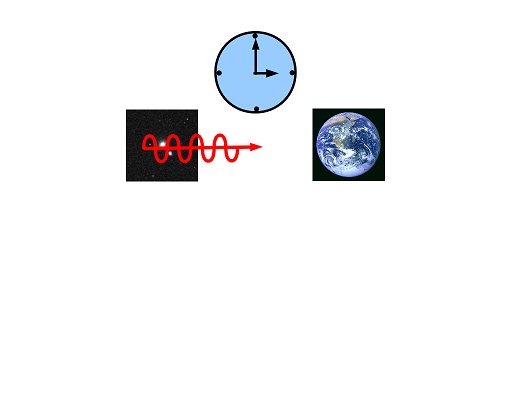
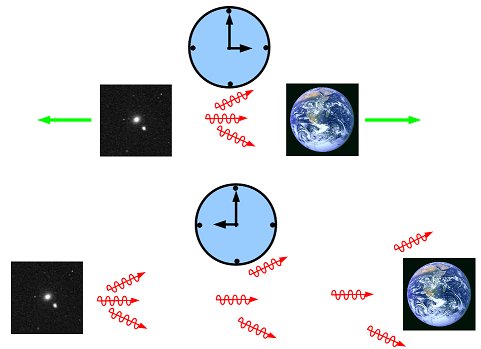
The further a galaxy is away from us, the more the light we receive from it has been stretched out
and spread out. Thus the further away a galaxy is, the dimmer it is. Now this dimming is even more
than just what the inverse square law of light would show, as the distance between the galaxy and
us has changed, stretching out the light and spreading it even more. Due to this a galaxy appears
dimmer than what it's comoving distance would suggest. It also partially explains why really far
away galaxies are so hard to see (I'll give you a hint as to another reason, searches for very
distant galaxies are done in the infra-red). This is called the luminosity distance. NGC 4860's
luminosity distance is 118 million parsecs or 386 million light years.
Now at distances below about a billion parsecs the differences between these four distance
measures is small enough to be ignored. However the farther out you go, the larger the gap between
the distances. For example one of the farthest galaxies known,UDFy-38135539 has a light travel
time distance of around 13.2 billion years, which works out to about 4 billion parsecs. The
comoving distance is much larger though at 9.3 billion parsecs (30 billion light years) and the
angular size distance is 970 million parsecs (3.2 billion light years). Way out there is the
luminosity distance at 88.8 billion parsecs (289 billion light years). If you look at the edge of the
visible universe you end up with a light travel time of 13.8 billion years (the age of the
universe, of course) which works out to 4.2 billion parsecs. The comoving distance to the edge of
the visible universe is 14 billion parsecs (46 billion light years). On the other hand the angular
size distance of the visible universe is only 1.4 million parsecs or 4.5 million light years.
Meaning that when the light of the cosmic background radiation started on it's way towards us, the
"surface" of the Big Bang was only twice as far from us as M31 is today. The luminosity distance
is an astronomical 141 trillion parsecs (460 trillion light years).
Now obviously this can cause an awful lot of confusion amongst astronomers and cosmologists when
discussing things that are a long ways away. To add to the confusion, the distances will also vary
depending on what values for the Hubble constant (Ho) and the amount of dark and visible matter
(Omega M) and dark energy (Omega vac) there is measured to be in the universe (for this article
I've used the numbers from the latest Plank satellite data release, Ho=67.15, Omega M=0.317, Omega
vac=0.683). So in generally for galaxies farther than a few hundred million parsecs astronomers
will use the red shift of the galaxy as an indication of its distance. Due to the expansion of the
universe, the further away a galaxy is from us, the faster it seems to be running away from us and
thus the further towards the red part of the spectrum its light appears when we observe it. The
red shift is represented by the letter z, so for NGC 4860 z=0.026, for UDFy-38135539 z=8.55 and
for the edge of the observable universe z is about 10000. The larger the value of z, the further
away the object is.
Of course an object's red shift value means little to most people so some form of distance needs
to be used. For most media releases this is usually the light travel time distance as you will
never get a distance larger than what people would understand as the size of the universe. But now
you know better!
If you want to do conversions from red shift yourself, there is a calculator here:
http://www.astro.ucla.edu/~wright/CosmoCalc.html
where you can enter in your Hubble constant value
(Ho), how much dark and visible matter (Omega M) and how much dark energy (Omega vac) and your red
shift value (z). Clicking on the "General" button will provide you with all four distances. You
can use the Plank satellite values I gave above or see how differences in these values changes the
scale (and age) of the universe.
|


