RASC Calgary Centre - Asteroid Parallax
Asteroid Parallax
by Jason Nishyama
Page last updated November 5, 2018
Determining the Astronomical Unit
This month, something more challenging, working out the distance to an asteroid, but first some
background information.
In the past two projects we've measured the distance to the inferior and superior planets in terms
of the Astronomical Unit. Until the 1600's the actual value of the AU was not known and hence the
actual scale of the solar system was also unknown. It wasn't until 1672 when Cassini used parallax
on the planet Mars to determine the solar parallax and hence the value of the AU.
Cassini did this by sending his assistant from Paris to French Guiana. Then at an agreed upon time
during Mars opposition, Cassini measured the position of Mars from Paris while his assistant
measured Mars' position from French Guiana. The shift in Mars' position (parallax) was caused by
the difference in location. Since the distance between the two sites was known, This formed a
baseline from which to determine the distance to Mars from the Earth in terms of whatever unit was
used to measure the distance between France and South America, see figure 1.
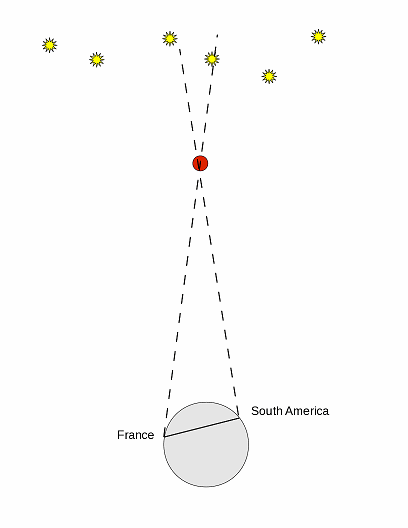
Figure 1
Now Cassini's measurement contained some error due to the fact that Mars is an extended object in
a telescope and he and his assistant were quite possibly measuring from slightly different parts
of Mars. A more accurate method is to use an asteroid of known orbit. Since the asteroid still
appears as a point source in most telescopes, two observers can't pick different locations on the
asteroid to measure from. Hence we'll be measuring an asteroid in this project.
To be clear up front, we'll also be cheating a bit. Unless you have a friend in Halifax who's
willing to help out, you'll have to use the Earth's rotation to create the baseline. Simple enough
but the Earth also moves in it's orbit during this time, and not an insignificant amount. In fact
if you measure an asteroid's parallax over a 6 hour period, only about 1% of the baseline comes
from the rotation of the Earth, the rest is the distance the Earth has moved in that time.
Computing the distance for the Earth's orbital motion is easy, you just need the Earth's orbital
velocity. The thing is if you know the Earth's orbital velocity, you can work out the AU by
working out how big around the Earth's orbit is (velocity time time it takes to do an orbit) and
then doing some maths.
So by compensating for the distance the Earth moves in its orbit is a bit of a cheat, but the the
exercise is still good in that the measurement techniques are the same (those of you playing the
home game and using planetarium software instead of observations don't have to cheat, since you
just set your location to two geographically different locations and note the shift in the
asteroid). So for this project you will need a telescope large enough to see the asteroid you've
chosen to observe and a stopwatch. An illuminated reticle is a nice option, but not necessary. The
telescope need not track as the measurement will be taken by using the Earth's rotation.
Choose any suitable main belt asteroid. One with a low number would work well as they tend to be
brighter and easier to spot. You will need to know three things about the asteroid: 1) when is it
at opposition? 2) What is it's distance from the Sun in AU and 3) where in the sky is it. The
first two pieces of information should be available in an almanac or the Observer's Handbook. The
third can be found in an almanac or the Observer's Handbook, but many planetarium programs also
show the location of asteroids and they can be used to create a map to locate the target
asteroid.
It is probably a good idea to work out where the asteroid is a couple of days before opposition so
you can check it's position from night to night. This will allow you to confirm which dim "star"
is the asteroid as it will move against the background stars from night to night.
On the night of opposition, find the asteroid 3 hours before midnight. You can use another time,
say 2 hours or so, as long as you wait the same amount of time past midnight to do the measurement
again. Set up the asteroid in the field of view so that it is almost on the western edge of your
eyepiece field of view, or if you have a reticle, to the east of one of the reticle lines. At this
point select a star that is fairly well east of the asteroid. When the asteroid hits the edge of
your field of view (or the reticle line) start your stopwatch. When the selected star reaches the
edge of the field of view or reticle line, stop the stopwatch. Record the time. It is important to
remember which star you used because you'll need it again later.
At this point wait till 3 hours (or whatever time you used) after midnight and do the measurement
again. Time how far from the same star the asteroid is using your stopwatch. Subtract the smaller
time from the larger one.
This time difference is the parallax of the asteroid caused by the Earth's rotation and orbital
motion (yes I know the asteroid moved too, but at its distance it didn't move enough for you to
measure). To convert from time seconds to arc seconds put the time difference into the following
formula:
p=(t x 0.2506545 x cos(dec))
Where p is the parallax in arc minutes, t is the time difference and dec is the declination of the
asteroid. Regular readers of this column will note that this formula is similar to the one in the
Venus orbital radii article, except now we're not dividing by 60. This is due to the fact that the
motion of the asteroid won't be more than about a minute of arc. You can use the degree formula
(we'll need the parallax in degrees later) if you wish.
Now that we have the data, time to crunch some numbers. The geometry of the situation is shown in
figure 2.
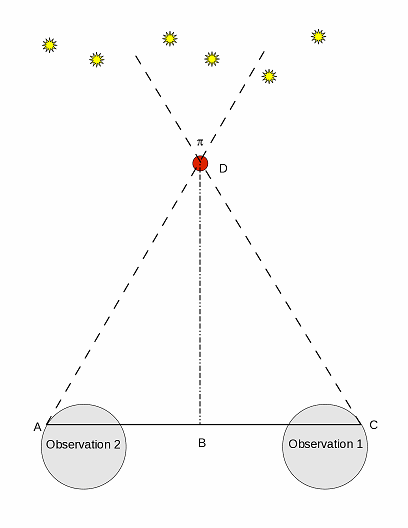
Figure 2
We know the angle shown by the Greek letter pi as it is the measured parallax. Angle ADC is the
opposite angle of pi so it is the same magnitude so angle ADC=angle pi. We can determine line AC
from the time we used and our geographic latitude through this formula:
AC= (6378 x cos L) x 2 x sin(0.5 x T x 15)) + (107229.6 x T)
where L is your latitude in degrees and T is the time between observations in hours (in the
instructions above, 6h). The first part of the formula works out the baseline caused by the
rotation of the Earth by computing the chord across a circle at your latitude and the distance
caused by the orbital motion of the Earth by multiplying the average orbital speed of the Earth
(in km/h) by the time between observations. Note that the orbital is a flat approximation of an
ellipse segment (the Earth's actual orbital path), but for the short time and distance involved it
will be very close.
Now we know one angle (ADC) and one side (AC) of the triangle. We still need more information to
solve the triangle (at least one other angle or one side). By selecting opposition as our
observation time, we've made triangle ACD an isosceles triangle. This means that angle DAC and
angle DCA are equal. Since the sum of all the angles in a triangle are 180, and we know one angle,
this makes the other two angles equal to (180-ADC)/2. These angles will be close to 90 degrees.
Remember to convert the parallax angle to degrees from minutes (divide by 60)!
Since angle DAC (or DCA) is so close to 90 degrees, a tangent function will be difficult to
acquire with accuracy. In this case we will use the law of sines to compute line DC (or DA) and
then use the Pythagorean Theorem to work out line DB, the distance to the asteroid from the Earth
at opposition. The formula below will provide the length of line DC:
DC = AC/sin(ADC) x sin (DAC)
where DC is the length of line DC in kilometres, AC is the length of line AC we computed above,
ADC is the angle ADC in degrees and DAC is the angle DAC we computed above, also in degrees. Now
by Pythagorean theorem:
BD^2=DC^2 x (AC/2)^2
So line BD is the square root of the difference of the square of line DC and the square of half
the line AC and this gives us the distance to the asteroid from Earth in kilometres.
All that's left now is to do a little arithmetic to work out the AU so:
AU= BD/(r-1)
where AU is the length of the astronomical unit in kilometres, BD is the distance to the asteroid
from the Earth in kilometres, and r is the orbital radius of the asteroid in AU.
Now with the knowledge of how long an astronomical unit is, we're now able to accurately judge the
scale of the solar system and from there the universe. With this and the two previous articles
we've just measured the first couple of rungs on the cosmic distance ladder!
|


