RASC Calgary Centre - Venus AU
Venus AU
by Jason Nishyama
Page last updated November 5, 2018
Measuring the Astronomical Unit - Venus Edition
Another article looked at measuring the astronomical uint using the parallax of a main
belt asteroid. With the transit of Venus in June 2012, I thought we'd look at how you
would use the transit of Venus to also measure the AU.
Now for those of us here in Calgary this was an intellectual exercise as we couldn't see
the whole transit from here. Though if you and a buddy have unlimited funds here's what you'll
need:
two telescopes with solar filters
two stopwatches
two airline tickets to two separate places where the transit is visible in it's entirety.
So let's say you and your buddy are off to do this, so one of of you flies off to Sydney,
Australia and the other flies off to Inuvik. At this point things are very simple, you both point
your solar filter equipped telescopes at the Sun then time how long it takes Venus to cross the
disk of the Sun.
This is trickier than you'd think though. It is difficult to tell exactly when the edge of Venus
touches the edge of the Sun (first and fourth contact), so people generally time from the point
Venus first completely enters the Sun (second contact), to where it first touches the Sun on the
way out (third contact). This is also difficult due to the "black drop" effect (see figure 1)
which makes it impossible to tell exactly when the contact happens. This causes huge timing errors
in practice making the transit of Venus a less desirable method of determining the AU.
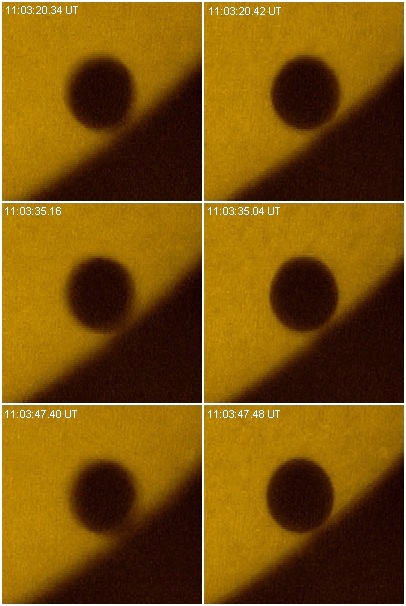
Figure 1 attribution: Wikimedia Commons, H. Raab
So after one of you has spent some time tanning on Bondi Beach and the other spent some time
feeding the mosquitos on the Mackenzie delta, you return with the your transit information. This
should look something like this (I pulled the data from NASA's prediction website at
http://eclipse.gsfc.nasa.gov/OH/transit12.html, also available in the 2012 Observer's
Handbook):
Inuvik transit time: 6:08:43
Sydney transit time: 5:52:08
We now have to work out the geometry of the situation. This will be a quick basic look. For a more
in depth derivation of the geometry check out section 3.5 of Stephen Web's book "Measuring the
Universe". Taking a look at Figure 2, we can see the basic geometry of the transit:
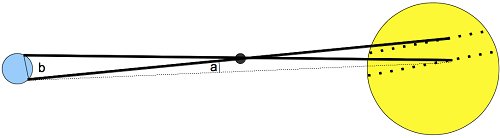
The two path's the observers see from their different locations on the Earth (at left) are visible
on the Sun (at right). We are interested in the values for b, the baseline between the two
observers and for a, the angle between the two apparent paths of the transit. Once we have these
two pieces of information, we can work out the astronomical unit.
The base line can be found from the longitude and latitude of the two observing sites as
follows:
We need to first set up a difference in Cartesian coordinates of both ends of the chord that is
the base. This is accomplished through the following formula:
dx = cos(lat_a)cos(long_a) - cos(lat_b)cos(long_b)
dy = cos(lat_a)sin(long_a) - cos(lat_b)sin(lat_b)
dz = sin(lat_a) - sin(lat_b)
where lat_a, long_a are the latitude and longitude of the first location and lat_b and long_b are
the longitude and latitude of the second location. So in our example:
dx = cos(68.3617)cos(-133.7306) - cos(-33.8600)cos(151.2111) = 0.4729
dy = cos(68.3617)sin(-133.7306) - cos(-33.8600)cos(151.2111) = -0.6664
dz = sin(68.3617) - sin(-33.8600) = 1.4867
Then using the Pythagorean Theorem:
ch = sqrt(dx^2 + dy^2 + dz ^2)
ch = sqrt((0.4729)^2 + (-0.664)^2 + (1.4867)^2) = 1.4106
All that remains is to multiply ch by the radius of the Earth (as ch is the chord length on a unit
sphere) so:
b = (6372 km) (1.4106) = 8987km
So we now know the baseline - b from Figure 2. We now need to work out the angle a.
We first need to find out the angular length of each transit track across the face of the Sun.
We'll make the following assumptions: 1) that the Sun's angular diameter is 31.5 minutes of arc
and that 2) Venus will take 7.875 hours to transit across the Sun's full diameter (I've adapted
these values from those in Webb).
With this data the angular length of each track can be worked out by:
at = 31.5' x (transit time in hours/ 7.875h)
so for Inuvik
at1 = 31.5' x(6.145278 h / 7.875h) = 24.58'
and for Sydney:
at2 = 31.5' x(5.868889h / 7.875h) = 23.48'
Some more Pythagorean math:
a = sqrt( 16^2 + (0.5 * at1)^2) - sqrt( 16^2 + (0.5 * at2)^2)
so for our example:
a = sqrt( 16^2 + (0.5 *24.58)^2) - sqrt( 16^2 + (0.5 * 23.48)^2) = 0.3302'
So the angle between the two tracks is 0.3302 arc minutes.
Now the Sun is close enough to the Earth to have a significant parallax between the to observation
locations. This works out to about 0.001338" per km of baseline so for our two cites this works
out to around 12" of arc. Adding this to our track angle nets us:
0.3302' +(12" / 60) = 0.5302 '
We'll need to convert that to radians:
a = (0.5302 /60) * pi/180 = 1.5423e-4 rad
Now we know both the baseline - b and the angle - a. We can now work out the astronomical unit
using the following formula from Webb (again see the book for the gory details):
AU = b/(0.383 * a) = 8987km /(0.383 * 1.5423e-4) = 1.54e8 km!
So about 154 million km, pretty close to the standard value for the AU at 150 million km.
It was through observations like this, as well as observations of asteroids and of Mars that
astronomers were able to give scale to the solar system and from there the universe. Though the
accuracy of using a Venus transit isn't as high as other methods, these observations did help
constrain the value of the AU and showed us that the solar system is a big place!
|


