The RASC Calgary Centre
Can circumpolar stars be seen in the southern sky?
By: Larry McNishPage last updated September 15, 2006
Circumpolar Stars: Stars of high Declination that circle around the Celestial Pole, never setting. |
|
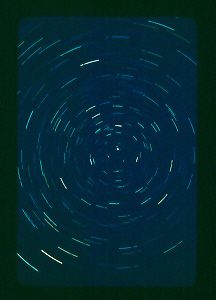 Long-exposure photo of the northern sky. Photograph by the author. |
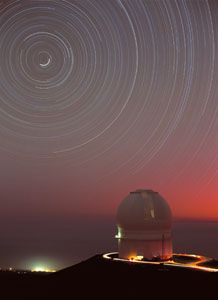 Star trails above the Canada-France-Hawaii Telescope. The shortest bright trail belongs to Polaris - the pole star. Photo by Richard Wainscoat. (Copyright image - used with permission.) |
| (For more pictures of star trails click these links: 1 2 3 4) | |
Circumpolar Stars
Lots of amateur astronomers have seen pictures of circumpolar stars, leaving their circular trails around the North Celestial Pole on long-exposure photographs like the ones above.
By definition, these stars never rise or set - they just circle the pole star forever.
So, you have to look towards Polaris to see them, and they never appear in the southern skies - right?
Wrong!
Depending on your observing location's Latitude, some circumpolar objects can be seen in the South.
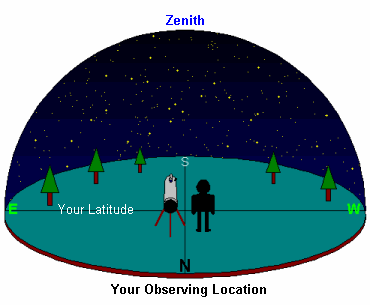
Let's start with the observing location and show some of the key terms used later.
(Definitions of many of these terms are given at the bottom of this page.)
 |
|
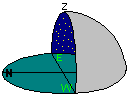 A "right side view" of the diagram above |
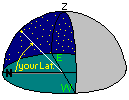 and where Polaris would be behind you |
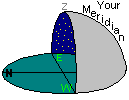 Side view of your Meridian |
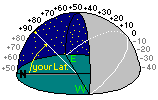 and the Declination Arc (for an observer at 45° Latitude) |
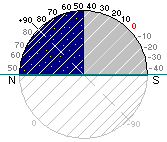 Side view of Declination Lines for an observer at 45° Latitude: - they are all parallel - the circles get smaller towards the Celestial Poles - only the Celestial Equator touches the exact E-W horizon |
|
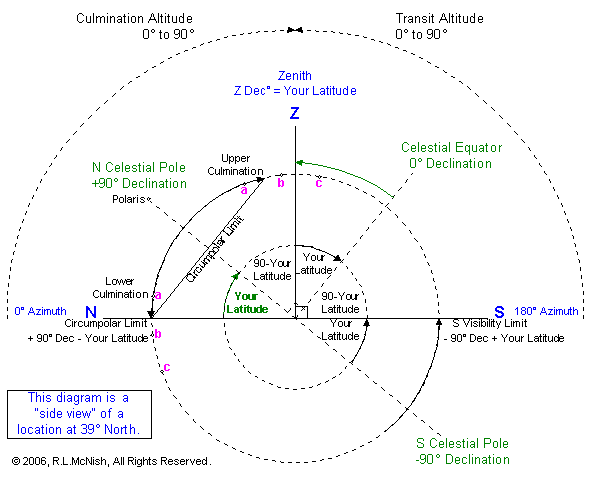
For N. Hemisphere observing locations at Latitude less than 45°:
Their circumpolar region is always North of the Local Zenith.
Therefore there are 3 types of visible objects: (see "a", "b" and "c" in the diagram above)
- Circumpolar objects that have a maximum altitude (North of the local Zenith) but which do not rise or set. Over a 24 hour period these objects pass 0° Azimuth twice - once lower to the northern horizon (Lower Culmination), and once higher towards the Local Zenith (Upper Culmination). They never cross 180° Azimuth since they never cross to the South of the Local Zenith. These objects have declinations higher than "90°-Latitude" degrees.
- Medium-high Declination but non-circumpolar objects that have one maximum altitude during any 24 hour period (still North of the local Zenith) as they cross 0° Azimuth between their rising and setting times (Upper Culmination). These objects have declinations between "90°-Latitude" and "Latitude" degrees.
- objects that have a Maximum Transit Altitude (South of the local Zenith) as they cross 180° Azimuth between their rising and setting times. These objects have declinations lower than "Latitude" degrees.
For N. Hemisphere observing locations at Latitudes greater than 45°

For N. Hemisphere observing locations at Latitude greater than 45°:
A portion of their circumpolar region lies South of the Local Zenith.
Therefore there are 3 types of visible objects: (see "d", "e" and "f" in the diagram above)
- High Declination circumpolar objects that have a maximum altitude (North of the local Zenith) but which do not rise or set. Over a 24 hour period these objects pass 0° Azimuth twice - once lower to the northern horizon (Lower Culmination), and once higher towards the Local Zenith (Upper Culmination). They never cross 180° Azimuth since they never cross to the South of the Local Zenith. These objects have declinations higher than "Latitude" degrees.
- Medium-high Declination circumpolar objects which do not rise or set. Over a 24 hour period. these objects pass 0° Azimuth low to the northern horizon (Lower Culmination), then reach a maximum (Transit) Altitude as they pass 180° Azimuth, high in the sky just south of the Local Zenith. These objects have declinations between "Latitude" and "90°-Latitude" degrees.
- objects that have a maximum Transit Altitude (South of the local Zenith) as they cross 180° Azimuth between their rising and setting times. These objects have declinations lower than "90°-Latitude" degrees.
Summary:
The further North you go above 45° Latitude, more circumpolar objects can be seen south of your Zenith.
Ultimately, at 90° Latitude (at the North Pole) everything you can see in the sky is circumpolar, and half of them are "south" of your Zenith at any time. They are all technically "south" of your Zenith because every direction is South from the North Pole. They all circle around you in 24 hours making every object visible at all Azimuths. The maximum Altitude any object reaches when viewed from the North Pole is just its Declination.
Definitions:
- Observer's Latitude:
- Your Latitude is your position on the Earth measured in degrees from 0° to +90° North of the Earth's equator or 0° to -90° South of the Earth's Equator. +90° Latitude is the Earth's North Pole. -90° Latitude is the Earth's South Pole. For a complete discussion of Latitude (and Longitude) click this link.
- Observer's Zenith:
- Your Zenith is the point on the night sky's "Celestial Sphere" directly above your observing location (i.e. straight "up"). (Note that this is not the position of Polaris - the Pole Star.)
- Observer's Meridian:
- Directly South of you, rising up perpendicularly from the South point on the horizon, up to your Zenith (crossing directly overhead), then rejoining the horizon directly north of you is an imaginary line in the sky known as your Meridian. Everything in the sky East of your Meridian is rising and everything West of your Meridian is setting - just like the Sun does. Everything high up on your Meridian has therefore reached its highest point in the sky tonight, and is therefore at its best for viewing since it is as far as it can be away from the (murky) horizons.
- Declination:
- Astronomical Declination is the position of an object on the Celestial Sphere measured in degrees from 0° to +90° North of the Celestial equator or 0° to -90° South of the Celestial Equator. +90° Declination is the North Celestial Pole. -90° is the South Celestial Pole. For a complete discussion of Declination (and Right Ascension) click this link.
- Altitude:
- Astronomical Altitude is the elevation angle of an object above your horizon measured in degrees from 0° (all the way around your horizon) to +90° (at your Zenith point). ("Horizon" means the equivalent to a sea-level horizon, not your actual horizon which varies according to local terrain.) These angles are fixed to your horizon and Zenith so, over time, astronomical objects that are rising will appear at higher altitudes, and those that are setting will appear at lower altitudes over the course of a night.
- Azimuth:
- Astronomical Azimuth is the direction angle of an object measured around the circle of your horizon. The true North direction defines 0° Azimuth and therefore South is 180° Azimuth. East is 90° Azimuth and West is 270° Azimuth. These directions (and therefore these angles) do not change so, over time, astronomical objects rising in the East and setting in the west will have continuously changing azimuths as they progress through the night.
- Transit:
- An astronomical transit occurs when a celestial body crosses your local Meridian due to the Earth's rotation, about halfway between its rising and its setting. At this time it reaches its maximum altitude. For instance, the Sun transits the meridian at "solar noon" which may deviate from our clock-driven "local noon". Observation of meridian transits were once very important for timekeeping purposes before the advent of standard time zones and accurate clocks.
- Upper Culmination:
- An astronomical object's Upper Culmination occurs at the time and place in the sky where it reaches its highest altitude on your Meridian. This term is usually applied to circumpolar objects which have both a highest visible crossing (Upper Culmination) and a lowest visible crossing (Lower Culmination).
- Lower Culmination:
- An astronomical object's Lower Culmination occurs at the time and place in the sky where it reaches its lowest altitude on your Meridian. If it is below the horizon at that time it is not visible so this term is usually applied to circumpolar objects.