Contents
On this page:
For more information on Telescope Mounting Systems - go to Page 2.
For more information on Telescope Accessories - go to Page 3.
For more Technical Information on Telescopes - go to Page 4.
For more information on Star Diagonals and Barlow Lenses - go to Page 5.
Telescope Basics
All telescopes have the same purpose - to collect light and bring it to a point of focus so it can be magnified and examined with an eyepiece.
The amount of light gathered depends upon the size of the primary objective lens and/or primary mirror.
This light-gathering power is the most important aspect of any astronomical telescope.
It makes very small, faint objects such as planets, moons, stars, galaxies and nebula
easier to see.
This light-gathering power is also the reason that you should never look directly at the sun through binoculars or a telescope - permanent eye damage or instant blindness can result !.
When you are out in the dark, the iris of your eye (the coloured part) shrinks, therefore the pupil of your eye (the black part) seems
to grow larger. The result is that more light enters your eye and reaches your retina (where it is converted to signals for your brain).
The average size of a fully dark adapted eye ranges from more then 7 millimetres (in younger people) to less than 6 millimetres (in older people).
The graph below (from a formula by James E. Birren, Roland C. Casperon, & Jack Botwinick, Age Changes in Pupil Size, J. Gerontol., #5, 1950, p.216.)
is just one example of how this changes with age. The picture shows how large your pupil can become. The second graph shows the
"light gathering power" of a telescope compared to the 7 mm eye for telescopes in the range of 1 inch to 10 inches. For example,
an 8 inch (diameter) telescope lens gathers about 800 times the amount of light your eye does!
  
Once the light has been focused it can be magnified by different amounts using different eyepieces.
This is why objects seem "closer" through a telescope. Higher magnification eyepieces take a smaller and smaller portion of the image and
enlarge it - much like the eyepiece of a microscope sees less of a sample but at a higher power each time the eyepiece is changed.
There are many different types of telescopes on the market along with many different ways to hold and point the telescope - from simple "alt-azimuth" mounts
to fully computerized auto-tracking motorized systems. On this page I will describe the three main types of
telescopes and some of the characteristics of telescopes. The next pages in this article discuss mountings, accessories and technical details. For more information on specific
telescopes, mountings, or accessories, please contact an astronomical telescope dealer.
How to get Help
OK, you are thinking about buying a telescope and want some help beyond the information you see here,
or you've just bought one and want some help setting it up and getting observing. So, where can you get help?
The answer is - The RASC. See our home page, contact one of our Executives,
or see our upcoming events, or come to a meeting and meet the members,
or even join the RASC and become a regular member.
Age is not a factor - we have Observing Groups for young and old, and our members really do enjoy helping people get into this hobby.
Types of Telescopes

|
Refractors

Refractors are a long, thin tube where light passes directly from the front
objective lens (blue) to the eyepiece at the opposite end of the tube.
The image is reversed left to right and top to bottom in an astronomical telescope.
If a "diagonal" eyepiece holder is used (see the pictures of the Schmidt-Cassegrain telescopes below)
then the mirror flips one of these directions back again.
Color correction is required since light of different colours will focus at
different points if a single objective lens is used.
Achromatic, apochromatic, fluorite, and ED multi-element objective lens
designs handle the colour correction.
Focus is controlled by moving the eyepiece holder in and out.
|


|
Reflectors - Newtonian or Dobsonian

Newtonian Reflectors use two mirrors (green) - a highly polished concave parabolic primary mirror to
collect and focus incoming light onto a flat secondary (diagonal) mirror
that in turn reflects the image out of an opening at the side of the main
tube and into the eyepiece. Without the secondary mirror the image would be created
at the open end of the telescope tube where attempting to view it would block the light entering the tube.
The Secondary mirror and its support structure (thin metal vanes) obstruct some of the light
but since the primary mirror is usually much larger than an average Refractor this is not much of a problem.
The image is reversed left to right and top to bottom by the primary mirror,
then the secondary mirror flips one of these directions back again (which one depends on the orientation of the telescope).
Color correction is not required. Alignment of the primary mirror, secondary mirror and eyepiece holder is necessary.
Focus is controlled by moving the eyepiece holder in and out.
|

 
|
Catadioptrics - Schmidt-Cassegrain or Maksutov

Catadioptrics use a combination of a large, thin aspheric Schmidt correcting lens (blue)
and two highly polished mirrors (green) - a large spherical primary mirror
and a smaller specially shaped secondary mirror.
The two mirrors "fold" the optic path (the light travels three times the length of the telescope tube)
then the light passes out an opening in the centre of the primary mirror, out the back of
the telescope and forms an image for the eyepiece.
There are two popular designs: the Schmidt-Cassegrain and the Maksutov-Cassegrain.
The Secondary mirror on the back of the primary lens obstructs some of the light
but since the primary mirror is usually larger than an average Refractor this is not much of a problem.
The image is reversed left to right and top to bottom. If a "diagonal" eyepiece holder is used (see the cutaway picture)
then the mirror flips one of these directions back again.
Color correction is not required. Alignment of the primary mirror, secondary mirror and eyepiece holder is necessary.
Focus is controlled by moving the entire primary mirror back and forth inside the telescope
by a knob protruding out the back. Although this is more complex than simply
moving the eyepiece in and out, it can accommodate a large number of optical assemblies
attached to the back of the scope (diagonals, porro prisms, barlow lenses etc.) and still
manage to bring the image to a focus.
|

|
Eyepieces
Eyepieces come in a large number of different sizes and designs
(some of these are shown in the cutaway drawing at the left).
More expensive designs usually have more (and better) glass elements
that affect the quality of the magnified image.
Aside from design, there are three primary factors to consider:
a) the size of the eyepiece holder on your telescope (0.96 inch, 1 1/4 inch, or 2 inches),
b) the focal length of the eyepiece (measured in millimetres), and
c) the "field of view" seen through the eyepiece.
The focal length of the eyepiece is the thing that controls the magnification
of the image - the smaller the focal length the larger the magnification.
Astronomers usually have a number of different eyepieces for their telescopes - low power
eyepieces for observing the Moon, medium power eyepieces for observing galaxies and nebula, and
high power eyepieces for observing the other planets and their moons.
See the Formulas section on page 4 to see how eyepieces affect the view through any telescope.
|
Finder Scopes and Polar Scopes
It is often difficult to find an object while looking through the eyepiece because astronomical telescopes typically magnify the image tens or hundreds of times
(conversely, they are viewing an extremely small section of the sky).
For this reason most telescopes have a smaller, low-power "finder" scope attached along the axis of the main telescope tube. This finder scope is used to point the main tube
at the object, which can then be centered in the field of view of the telescope with only minor pointing adjustments. Some "Equatorial" telescope mounts actually have a third small telescope - a
"polar alignment" telescope that helps point the axis of rotation of the telescope at the north star. Then, as the earth rotates, only a single correction is needed
to keep the telescope on an object, instead of having to move the telescope up/down and left/right.
An Example of a Telescope System
Any reasonable astronomical telescope is going to give you hours of observing pleasure. It is important, though, to
acquire a telescope that can grow with you as you explore different areas of the hobby:
- visual observing - moon, planets, stars
- deep sky observing - galaxies, nebula
- astrophotography - film, CCD etc
- research astronomy - variable star observing, asteroid occultations, supernova
- discovery - looking for new comets or supernova
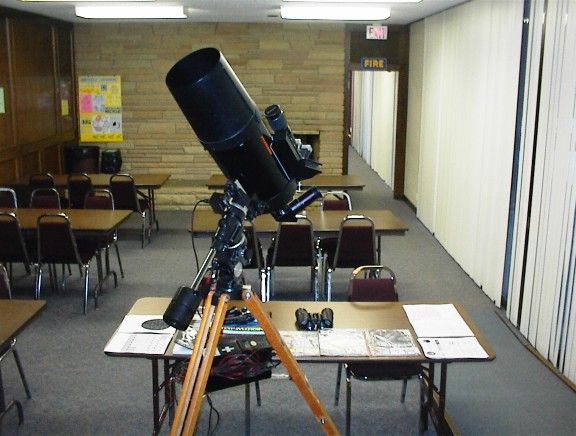
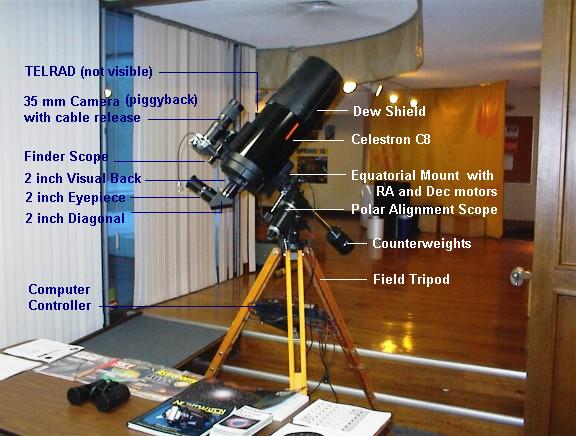
I purchased the system shown below in 1986 and have been using it ever since (that's 19 years). From this you can
see that if you purchase the right kind of scope for you, you can add to it over the years and create quite a telescope system
that can do all of the types of astronomy listed above. You do not have to buy all of this
at one time - just start with the basics and add things as you branch out into other areas.
|