The RASC Calgary Centre
Can a telescope see the Lunar Landers or Lunar Rovers on the Moon?
By: Larry McNishPage last updated November 5, 2018
(Page originally created Feb 11, 2006)
Interested in Astronomy? Become a member of the RASC! Click here to find out about RASC membership and RASC publications. |


(All lunar photographs are from NASA)
1. Are there telescopes that can see the Lunar Landers or the Lunar Rovers on the Moon?
2. What kind of telescope would be needed to observe them?
3. How About Hubble?
4. What would it take to see them?
5. So how else do we know that the landers and rovers are there?
6. Is there another way to "see them"?
7. Any chance of seeing the US flags on the Moon?
8. July 17, 2009, Sept 3, 2009, Oct 1, 2009 - Apollo Landing Sites imaged by satellite after almost 40 years!
|
1. Are there telescopes that can see the Lunar Landers or the Lunar Rovers on the Moon? Good question.
2. So, what kind of telescope would be needed to observe them, sitting there, after almost 40 years? In order to answer the question, we're going to use some math using trigonometry and one of the many formulas that determine how well a telescope performs. First, some information about the Apollo equipment:
Next, some basic information about the Moon and the Earth:
From the two tables above we can calculate that the Lunar Lander body is 4.2 metres / 3,475 kilometres = 0.000 001 209 times the width of the Moon (or about 1 millionth its size) and the Lunar Rover is even smaller, about 0.000 000 892 times the width of the Moon (or less than 1 millionth its size). So, if you were looking through a telescope, and the Moon filled the whole eyepiece view, you would be looking for something about 1 millionth that width. Put another way, we would need 827,381 Lunar Landers parked side-by-side to equal the width of the Moon, but the line of them would only be 1 millionth of the vertical dimension. The angular size of the Moon, The Landers and the Rovers. We measure everything "out there" through a telescope using angular measurement since it is so difficult to get "out there" with a ruler. 
(note: an "arc-second" is 1/3,600 degree)
Telescope Resolution: When trying to see things that are very small, or small things that are very close together, all telescopes are affected by something called the Smallest Resolvable Angle (known as the Dawes limit). You can read more about "Dawes Limit" and the related "Rayleigh Criterion" here. This angle = 116/D seconds of Arc, where D is the Diameter of the objective lens or mirror (in millimetres) (if you are using inches then the angle = 4.56 / D) Some Examples:
**Note: Atmospheric limitation on the Smallest Resolvable Angle = 0.5 arc seconds, which means that without special, adaptive optics systems, the average Earth-based telescope can only resolve things down to 0.5".
From the above table, even ignoring the limitation imposed by Earth's atmosphere we can see that we would need an optical telescope with an objective mirror
about 100 meters (about 328 feet) in diameter to just about be able to see the landers and the rovers.
Since the largest Optical telescope in the world is only 10 meters in diameter, the cost of building such a telescope could be more than the cost of going there and taking a picture with a normal camera. 3. How About Hubble? But what about the Hubble Space Telescope? It's in orbit around the Earth and is not subjected to the same atmospheric problems as ground-based telescopes. Can Hubble see them? Unfortunately, no. Hubble's primary mirror is only 2.4 meters in diameter which means its smallest resolvable angle is 0.000 018 33 degrees or 0.066 arc seconds - about 30 to 40 times less than what is needed. Even the new Faint Object Camera with superb resolution of about 0.0072 arc-seconds can't see them either. (If we could put the Hubble Space Telescope a lot closer to the Moon we might be able to see them, but we can't do that.)
But how can this be? Hubble takes fantastically detailed pictures of galaxies thousands of light-years away.
Why can't it resolve things on the Moon which is right next door?
Answer: Hubble was designed to take pictures of things that are very far away, but which are also very, very big!  Hubble has taken Moon shots and they are very clear, but it just does not have the angular resolution needed. To help you see the problem, the image below is a scale diagram of the Earth-Moon system, showing the true relative sizes and distances involved (scroll right to see the entire image). Photographs or diagrams you may have seen showing the Earth and Moon together give a very false impression of how far away the Moon really is. Now imagine trying to get a clear picture of something 1 millionth the size of the Moon. |

|
4. OK - what would it take to see them? If we could put different sized telescopes in orbit around the Moon we could accomplish this. The resolution of a space-based (diffraction-limited) telescope is given by the formula: resolution (in radian measure) = 1.4 L/D resolution (in arc seconds) = 1.4 L/D * 180 / π * 3600 Where:
Using 0.42 metres for "W" and calculating the distance from the Moon for various telescope sizes we get:
In other words, Hubble would have to be in orbit around the Moon at an altitude of 1300 km or less, instead of in orbit around the Earth at about 350 km altitude. 5. OK, so how else do we know that the landers and rovers are there?
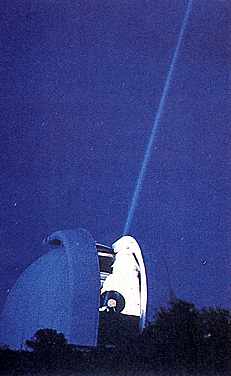
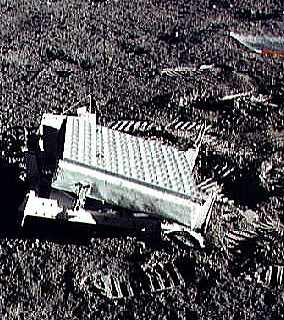
6. Is there another way to "see them"? Maybe - here's a challenge to those who are reading this. The 2-dimensional diagram below shows the orientation of the Lunar Lander(s) on the Moon's surface during a Lunar month. Since the Moon always presents the same face to the Earth (the side the Apollo astronauts landed on), the "top" of the Lunar Landers Descent Stages (the part left on the Moon when the Astronauts left) generally point towards the Earth (i.e. we never see them "sideways"). As the Moon orbits the Earth, each point on the Lunar surface experiences sunrise, noon, sunset and midnight, except that it takes a full month to go through the cycle instead of an Earth day. From "Local Sunset" (at the top of the diagram) to "Local Sunrise" (at the bottom of the diagram) the landing sites are in darkness except for very weak "Earthshine" (i.e. the whole left side of the diagram). However, from Local Sunrise, through Local Noon, to Local Sunset, (the right side of the diagram) the landers are illuminated by bright sunlight at varying angles. A lot of the Descent Stage was covered in bright gold foil and there might be other polished surfaces that could reflect some sunlight towards the Earth. The reflectivity of the Moon's surface (its albedo) averages 0.12 (i.e. it reflects about 12% of the light hitting it). In order for us to see a flash, the reflective surface on the lander would have to be oriented correctly, and have a reflection coefficient much greater than 12% after 33+ years of sitting on the lunar surface. The angle of these surfaces would have to be as shown in the diagram, but the angle continuously varies from 45° through 0° (flat) and back to 45° over the period from First Quarter Moon to Last Quarter Moon.  The exact coordinates of all landers are well known and are spread across the Moon's Surface.  The actual 3-dimensional reflection angles involved are more complicated than the simplified 2-dimensional diagrams above. As pointed out by self-confessed New Zealand "space nut" Doug Bennett:
If someone were to videotape the landing zones continuously over this two-week period, we might see a flash from one or more landers as the sun angle and a piece of the spacecraft line up exactly to reflect sunlight into the observer's camera. The exact timing and angles are not known well enough to predict this. Also, since the Earth is rotating daily "under the Moon" we would need 2 or more cameras spread around the world, trained on the Moon at all times, in order to provide continuous coverage. The cameras would have to spend some time "zoomed in" on each site in turn, so the whole process would take several months (not including "re-takes" due to cloud cover or poor "seeing". There have been other flashes observed and photographed on the Moon:
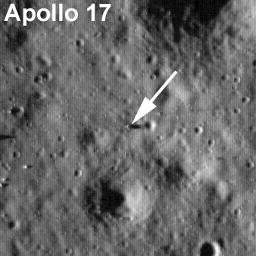
Is anyone up to this challenge? 7. The Flags on the Moon Can we see the American flags planted on the Moon by the U.S. Astronauts? The answer is Not Even Close! Take another look at the "Apollo Lunar Lander Orientations during a Lunar Month" diagram above. The flag poles are are more-or-less vertical on the Moon (having been driven in by hand) which means they point generally upwards towards us on the Earth (see the discussion on actual angles above) - except for Apollo 11's - Buzz Aldrin saw the Apollo 11 flag fall over as the ascent stage took off from the Moon. The poles have a diameter hundreds of times smaller than the landers and the nylon flags themselves would be just a thin line, if they still exist at all after being blasted by solar radiation, UV, and sunlight for 33+ years. i.e. they might look something like the diagram on the right below. We would have to be right on top of them to see them, on the other hand, their shadows might be used as a sundial.   Side note - some people, having seen the following picture (or the video) assumed the Earth was on the horizon while the astronauts were on the Moon. This is not the case. The photograph was taken from the orbiting Command Module, circling the Moon. The landing sites were all timed to occur during local "dawn" on the moon about at the location of the Moon's terminator to take advantage of the oblique sun angle (as can be seen above) and slightly cooler temperatures. The Earth, however, was almost directly overhead of the landing sites as can be seen in the large diagram above. Also check the angle of the "corner reflector" in the photo above and you'll see that it is laying almost "flat", i.e. aimed "up" at the Earth from that lander's lunar position.  8. July 17, 2009, Sept 3, 2009, Oct 1, 2009 - Apollo Landing Sites imaged by satellite after almost 40 years! As I stated above (several years ago), it would take a pretty good telescope in Lunar orbit to be able to resolve the Apollo landing sites. Well, it's happened. On July 17, the Lunar Reconnaissance Orbiter released its first pictures of the Moon, including most of the Apollo landing sites taken with LROC - the 195mm LRO Cameras from a height of approximately 50km. See the following links for the story
In September 2011, the LRO site released newer, closer, better photographs of the Apollo sites fro a much lower orbit. See: http://www.nasa.gov/mission_pages/LRO/news/apollo-sites.html. http://www.nasa.gov/mission_pages/apollo/revisited/index.html
Finally, if you're reading this page not to learn about angular resolution, but because you have heard something about a "moon landing hoax" then I suggest you visit the following sites:
| |||||||||||||||||||||||||||||||||||||||||||||

 January 6, 2014