This page provides links or information about various programs or observing projects where specific members of the Calgary Centre are a principal investigator or are otherwise promoting.
If you are involved in an astronomy-related project send me the information and I'll add it to this page.
The Sandia All-Sky Camera
- Location - South Calgary. (Information on the exact location is restricted to protect the site).
The camera is operated by Don Hladiuk who also creates the monthly SKY HIGHLIGHTS
information for this web site and the popular CBC Radio One Calgary Eyeopener "Astronomy Segment",
heard on the CBC radio morning show the first Tuesday of each month at 6:22 AM local time.
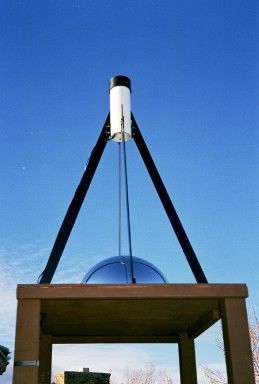
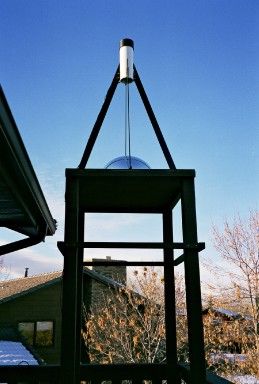
- The Camera - As seen in the images below, the Sandia All-Sky Camera is
a monochrome video camera mounted vertically (pointing down) above a convex hemispherical polished dome
51 cm (20 inches) in diameter. From this vantage point, the camera can see the entire
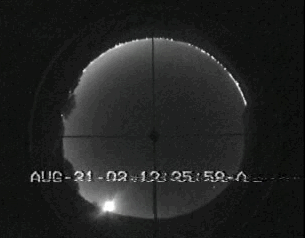
sky reflected in the dome from horizon to horizon - a full 360 degrees with the zenith at the centre of the round field-of-view.
The height of the camera above the dome, (71 cm or 28 inches) reduces
the apparent size of the support struts and the image of the camera itself.
The top support strut is pointing approximately 30 degrees N.E. in azimuth.
The camera is connected to 3 VHS video recorders which record 24 hours per day.
The tapes are changed daily (unless Don is away on vacation), and kept for 8 to 10 days then recycled.
To process the tapes into mpeg files Don Hladiuk uses a firewire connector to hook up the tape machine
to his computer and uses Ulead Studio as a cheap recording/editing package to produce short little clips
(the files can get very big in a hurry).
.
- A Brief History - In late 2000, Don pointed an old Sony video camera
with a wide angle lens out his South Calgary living room window
in hopes of capturing the image (and path) of any bright meteor over
the prairies that could lead to the recovery of a meteorite. The camera only recorded
during the nighttime hours and VHS tapes were changed daily on a single VCR. Then on January 25,
2001 Don was rewarded with a successful recording. A paper was published on the event
in JRASC in late 2003. (No meteor was ever located.)
About the same time, Dr. Alan Hildebrand (U of C) was looking for volunteers to operate
a more effective all-sky system built by Sandia Laboratories. The system was activated
in south Calgary in the fall of 2001 and has since recorded numerous bright meteors and
fireballs. Don's camera is one of a network of cameras across North America
that started with The Meteorite Observation and Recording Program (MORP).
For more information see The Meteorite and Impacts Advisory Committee
to the Canadian Space Agency. (MIAC)
.
Many thanks to Dr. Alan Hildebrand
(MIAC Chairman) and the University of Calgary for offering the hardware and support for this all sky monitoring project.
- Spread The Word! - The camera captures the sky every day, but we need observers
to alert us to any events that happen. This volunteer effort does not include sitting in front of a monitor 24 hours a day
looking for fireballs, meteors or the like! Tell your friends and neighbours that if they see any bright
incidents in the daytime or nighttime sky to notify Don or the WebMaster of the date and time of the event.
Don then reviews the appropriate tape for any evidence.
From the tape Don can determine the exact time, the azimuth, the elevation, apparent brightness, direction and duration.
- Images
- Back to Top
|