An easy double star, components are mag.
3.0 and 5.5. Separation is 19.6 arc seconds in P.A. 228°, colours are bluish-white and white.
U Canum Venaticorum
12hr 45m
+45° 26'
A semi-regular variable of 160 days, varying from mag
4.8 to 6.3. One of the reddest stars known, Y is a carbon star glowing at 2600° K, spectral class N. Try
defocussing the star slightly to help make the colour more obvious.
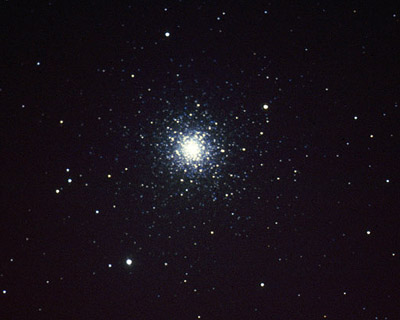
M3! (NGC 5272)
13hr 42.2m
+28° 23'
A bright mag 6 globular cluster, visible in binoculars. 18 arc minutes in
diameter, can be resolved to the core with a 12 inch scope.
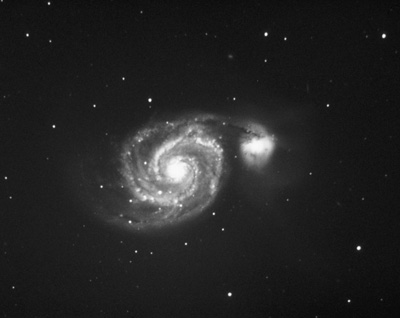
M51! (NGC 5194/5)
13hr 29.9m
+47° 12'
The "Whirlpool Galaxy" - a bright interacting face-on Sc spiral galaxy with NGC 5195. Mag 8.7,
covering 5.5 x 10 arc minutes. Visible in large binoculars, considerable detail in larger scopes.
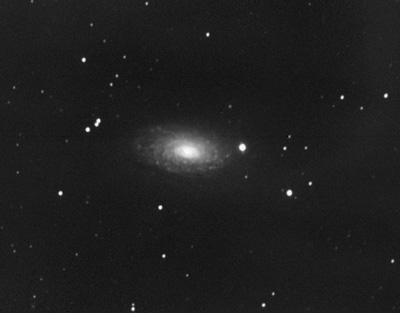
M63! (NGC 5055)
13hr 15.8m
+42° 02'
The "Sunflower Galaxy" - a mag 9.8 multi-arm Sb spiral , 9 x 4 arc minutes. A bright core is visible
in smaller scopes, spiral arms will require large aperture. Same distance as M51 - 10 megaparsecs.
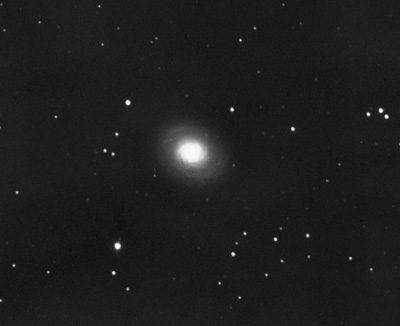
M94 (NGC 4736)
12hr 50.9m
+41° 07'
A bright, compact, tightly wound mag 8.9 Sb galaxy. 5 x 3.5 arc minutes,
with a very intense nucleus. Spiral arms are fainter, large scopes needed to observe any detail.
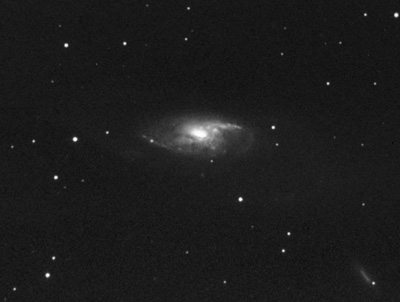
M106! (NGC 4258)
12hr 19.0m
+47° 18'
An Sb spiral with very high surface brightness. Mag. 9.0, 19.5 x 6.5 arc
minutes. Larger scopes show detail in the disturbed core - also a bright radio source.
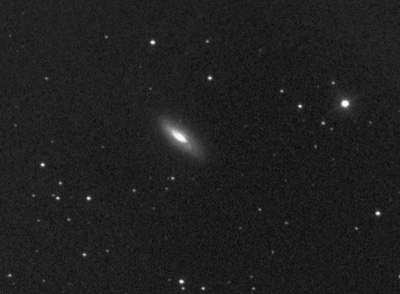
A magnitude 10.8 S0 galaxy - bright, small and very elongated. 4.8
x 1.1 arc minutes. (110NGC)
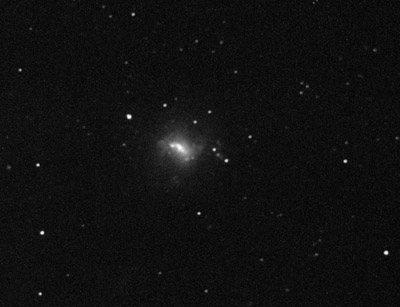
NGC 4214!
12hr 15.6m
+36° 20'
An irregular galaxy. Mag 9.7, 7.9 x 6.3 arc min.(110NGC)
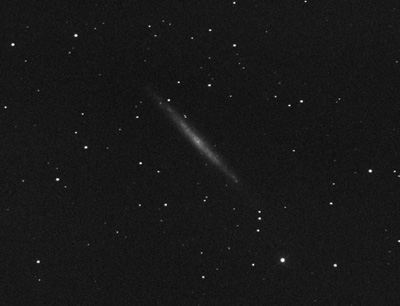
NGC 4244!!
12hr 17.5m
+37° 49'
A bright Sb edge-on spiral, NE of NGC 4214. Mag 10.2, 16 x 2.5 arc
minutes with good surface brightness. (110NGC)
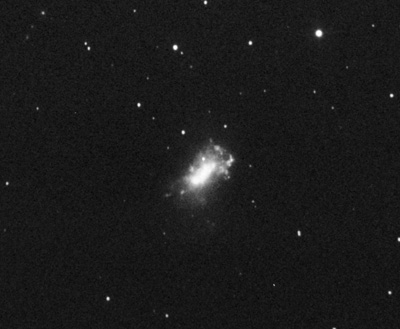
NGC 4449!
12hr 28.2m
+44° 06'
A mag 9.4 irregular galaxy, 5.1 x 3.7 arc minutes. (110NGC)
NGC 4490! and NGC 4485
12hr 30.6m
+41° 38'
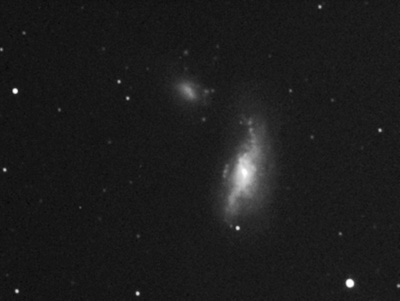
The "Cocoon Galaxy" - an interacting pair of galaxies. (4485 is irregular, 4490 Sc (110NGC)) Mag.
12.5 and 10.1, 1.3 x .7 and 5 x 2 arc minutes. Visible with a 6 inch scope.
NGC 4631!!
12hr 42.1m
+32° 32'
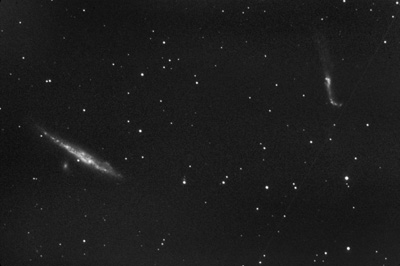
A large, bright mag 9.3 Sc spiral. 15.1 x 3.3 arc minutes. Large
amounts of dust give it a mottled appearance. Look for 12.5 mag NGC 4627 2.7 arc min away. (110NGC)
NGC 4656!! and NGC 4657!
12hr 44.0m
+32° 10'
Located in the same low power field as NGC 4631, this Sc spiral
measures 13.8 x 3.3 arc minutes. NGC 4657 sits on the NE end. (110NGC)
NGC 5005!
13hr 10.9m
+37° 03'
Yet another bright Sb galaxy, near a CVn. Mag 9.8, 5.4 x 2.7 arc
minutes.(110NGC)
NGC 5033!
13hr 13.4m
+36° 36'
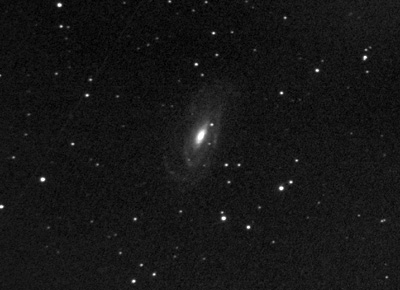
An Sb spiral galaxy, located SE of NGC 5005. Mag 10.1, 10.5 x 5.6
arc minutes. Larger than 5005, but of lower surface brightness. (110NGC)
Photo 1 - The globular cluster M3.
South is at top to match the view in an inverting telescope.
Photo credit: John Mirtle.
Photo 2 - The "Whirlpool Galaxy" - M51 (NGC 5194) and NGC 5195.
South is at top to match the view in an inverting telescope.
Photo credit: John Mirtle.
Photo 3 - The "Sunflower Galaxy" - M63.
South is at top to match the view in an inverting telescope.
Photo credit: John Mirtle.
Photo 4 - The compact galaxy M94.
South is at top to match the view in an inverting telescope.
Photo credit: John Mirtle.
Photo 5 - The galaxy M106.
South is at top to match the view in an inverting telescope.
Photo credit: John Mirtle.
Photo 6 - The irregular galaxy NGC 4214.
South is at top to match the view in an inverting telescope.
Photo credit: John Mirtle.
Photo 7 - The edge-on spiral galaxy NGC 4244.
South is at top to match the view in an inverting telescope.
Photo credit: John Mirtle.
Photo 8 - The irregular galaxy NGC 4449.
South is at top to match the view in an inverting telescope.
Photo credit: John Mirtle.
Photo 9 - The "Cocoon Galaxy" NGC 4490 and NGC 4485.
South is at top to match the view in an inverting telescope.
Photo credit: John Mirtle.
Photo 10 - Galaxies NGC4631 (left) and NGC 4656 (right).
South is at top to match the view in an inverting telescope.
Photo credit: John Mirtle.
Photo 11 - The galaxy NGC 5005.
South is at top to match the view in an inverting telescope.
Photo credit: John Mirtle.
Photo 12 - The galaxy NGC 5033.
South is at top to match the view in an inverting telescope.
Photo credit: John Mirtle.